
What Is a Desk Study in Construction
A desk study in construction is a crucial, non-intrusive initial investigation where a professional reviews existing documents, maps, and records to assess a site’s potential constraints and risks before any physical work begins. It helps identify issues like flood zones, contaminated land, or underground utilities, allowing for better planning and avoiding costly surprises. This foundational step is vital for homeowners and developers to make informed decisions and secure planning permission.
Key Takeaways
- It’s a paper-based investigation: A desk study involves researching historical and current records, not digging up the site.
- It identifies hidden risks: It uncovers issues like flood risk, contaminated land, rights of way, and underground services.
- It’s required for planning: Most local planning authorities expect a desktop study as part of a planning application.
- It saves significant money: Finding a problem on paper is far cheaper than discovering it during excavation.
- It informs the design: Findings dictate foundation design, drainage solutions, and building orientation.
- It’s not a substitute for a site survey: It often leads to recommendations for more detailed physical investigations.
📑 Table of Contents
- Introduction: The Foundation of Any Smart Building Project
- What Exactly *Is* a Desk Study? (The Simple Definition)
- Why Is a Desk Study So Important? (It’s Not Just a Form-Filling Exercise)
- What’s Inside a Typical Desk Study Report? Breaking Down the Components
- The Step-by-Step Process: From Commission to Report
- Common Pitfalls and Misconceptions
- Conclusion: Your First and Most Important Investment
Introduction: The Foundation of Any Smart Building Project
So, you’ve found the perfect plot. You can already see your dream kitchen, the sunny garden, or the extension that will give your growing family that much-needed space. It’s exciting! But before you get carried away with paint swatches and furniture layouts, there’s a critical, often overlooked, first step: the desk study. Think of it as the detective work of the construction world. Instead of a magnifying glass, we use old maps, land registry records, and environmental databases. Instead of interviewing suspects, we research flood history, contaminated land registers, and underground utility plans.
For a homeowner, this might sound like bureaucratic nonsense. Why spend money on research when you can just start building? Here’s the truth: skipping this step is like buying a house without a survey. You might be fine, but you could also be buying a money pit. A desk study is your first line of defense against unforeseen, and potentially catastrophic, problems. It’s the process that answers the question: “What are we *really* building on?” In this complete guide, we’ll unpack exactly what a desk study in construction is, why it’s non-negotiable for a stress-free project, and what it typically involves. By the end, you’ll understand why this ‘paper chase’ is the smartest investment you can make in your construction journey.
What Exactly *Is* a Desk Study? (The Simple Definition)
Let’s cut through the jargon. A desk study—also often called a desktop study or pre-acquisition assessment—is a comprehensive review of all the existing, publicly available information about a piece of land or a property. The key word here is “desk.” It means the investigation is conducted from an office, using a computer and reference materials, without any physical disturbance to the ground. A qualified environmental consultant, engineer, or chartered surveyor is commissioned to compile and analyze this data.

Visual guide about What Is a Desk Study in Construction
Image source: anthonyhaycabinetmaker.files.wordpress.com
What Gets Researched? The Digital Paper Trail
The researcher becomes a digital archaeologist, digging through layers of historical and contemporary data. This typically includes:
- Historical Maps and Aerial Photographs: These can reveal the site’s past uses. Was it an old gasworks? A farm with slurry pits? A former landfill? A previous building with asbestos? Old orchards (potential soil contamination from pesticides)? The past use of land is the single biggest indicator of potential contamination.
- Land Registry and Title Deeds: These documents establish legal boundaries, ownership, and crucially, any restrictive covenants or easements (like a right of way for a neighbor or utility company). You can’t build over a legal sewer easement.
- Planning History and Local Plan: You’ll check what has been approved or refused on the site before, and what the local council’s long-term plan is for the area. Is your plot designated for something else? Are there any Article 4 directions removing permitted development rights?
- Environmental Databases: Consultants access official registers for:
- Contaminated Land: The Environment Agency’s and local councils’ registers of known contaminated sites.
- Flood Risk: Detailed flood maps from the Environment Agency showing risk from rivers, seas, surface water, and reservoirs.
- Ground Stability: Data on mining (coal, brine, tin), natural hazards like landslides, and previous ground investigations.
- Protected Species and Habitats: Is the site near a Special Area of Conservation (SAC) or have records of bats, great crested newts, or nesting birds?
- Utility Plans: Plans from water, sewer, electricity, gas, and telecoms providers showing the approximate location of their underground and overhead apparatus. Striking a high-pressure gas main is a worst-case scenario you absolutely want to know about beforehand.
- Radon Gas Data: Public Health England provides maps showing areas with elevated radon levels, a radioactive gas that can seep into buildings from the ground.
The output is a desk study report, a clear document that synthesizes all this information, highlights the risks, and makes recommendations for next steps.
Why Is a Desk Study So Important? (It’s Not Just a Form-Filling Exercise)
If the definition sounds dry, the importance is anything but. This section is the “why” that should motivate every prospective builder.
Visual guide about What Is a Desk Study in Construction
Image source: i.pinimg.com
1. It’s Your Legal and Planning Shield
Under the Planning and Compulsory Purchase Act 2004 and National Planning Policy Framework (NPPF), UK planning authorities have a duty to consider contamination and flood risk. Submitting a planning application for a new build or major extension without addressing these issues is a surefire way to get your application refused or delayed. The council will expect you to have done your homework. A robust desk study demonstrates you’re a responsible developer, proactively identifying and planning to mitigate risks. It’s your evidence that you’ve followed the “precautionary principle.”
2. It Prevents Financial Disaster
This is the biggest reason for homeowners. Discovering contaminated soil during excavation can add tens, even hundreds, of thousands of pounds to your budget. You might need special waste disposal, ground treatment, or even a complete redesign of foundations. Finding out your site is in a high flood risk zone on paper means you can design accordingly (e.g., raising ground floor levels, using flood-resistant materials) or, in a worst-case, abandon the purchase before you’ve spent a penny on bricks and mortar. The cost of a desk study is a tiny fraction of the cost of dealing with a surprise underground storage tank or a history of mining subsidence.
3. It Informs and Improves Your Design
Knowledge is power in design. If the desk study flags a significant tree with a Tree Preservation Order (TPO) on the boundary, your architect can design around it instead of applying for a removal that might be refused. If it shows a sewer runs across the rear of the plot, you can plan your extension to avoid it, saving a costly diversion. If it identifies a strong prevailing wind direction, it can inform window placement and garden design. The study turns constraints into considered design inputs.
4. It Manages Risk for Your Builder and Mortgage Lender
Your builder will be deeply wary of a site with unknown risks. Unforeseen ground conditions are one of the top causes of project delays and disputes. A desk study gives them clarity, allowing for a more accurate and fixed-price quote. Furthermore, if you’re using a mortgage to fund the build or purchase, your lender’s surveyor will want to see evidence that environmental risks have been assessed. A clean desk study report can be a condition of your mortgage offer.
In short, the desk study transforms the unknown into the known. It moves you from hopeful guesswork to informed planning. It’s the single most cost-effective piece of due diligence you can undertake.
What’s Inside a Typical Desk Study Report? Breaking Down the Components
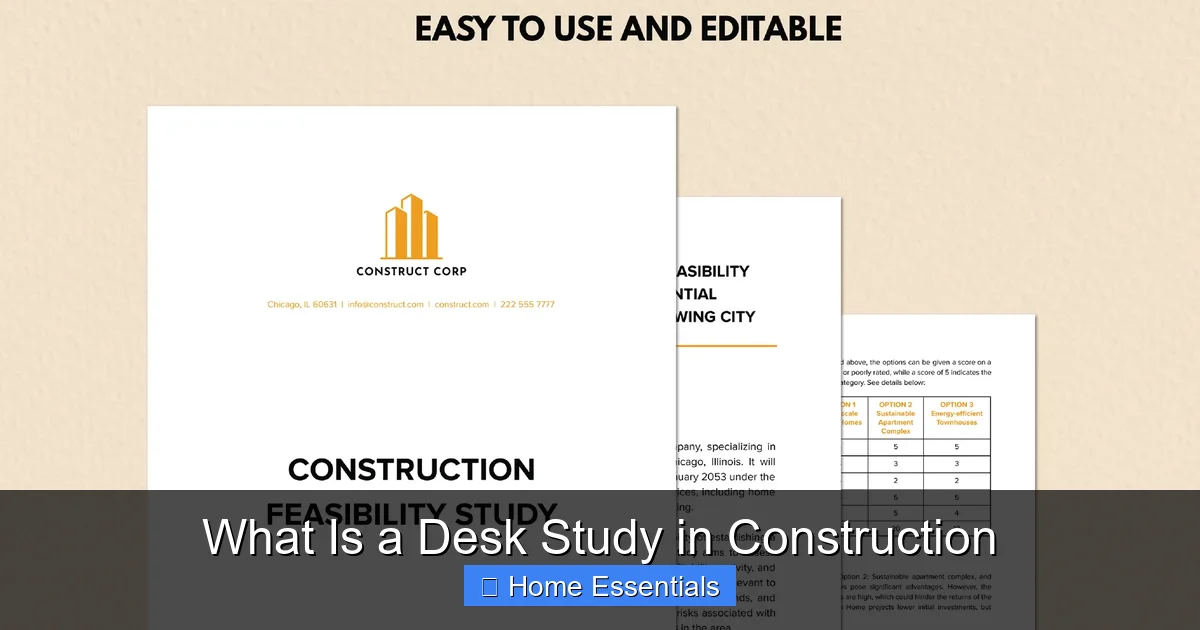
Not all reports are created equal, but a good one will follow a logical structure. Here’s what you should expect to find in a professional desk study report:
Visual guide about What Is a Desk Study in Construction
Image source: images.template.net
Executive Summary
This is the most important page for a homeowner. It’s a clear, jargon-free summary of the key findings and the consultant’s overall opinion on the site’s suitability for development. It will state if the site is considered “low risk” or if further investigation is recommended.
Site Description and Setting
A detailed description of the site’s current use, topography, vegetation, and surrounding area. This sets the scene and confirms the physical reality against the paper records.
Historical Land Use Assessment
This section presents the findings from the map regression. It will show old maps side-by-side and list all past uses identified (e.g., “1940s map shows a garage with fuel tanks; 1960s map shows an industrial unit”). Each historical use is assessed for its potential to have caused contamination.
Environmental Database Searches
This is the data-dump section, listing all the registers checked and the specific results for your site’s postcode or grid reference. It will confirm whether the site is:
- Within a Flood Zone (and which zone: 1, 2, or 3).
- In an area of known contaminated land.
- In a coal mining area (with a recommendation for a CON29M search).
- In a radon affected area.
- Near a Site of Special Scientific Interest (SSSI) or other ecological designation.
Planning and Legal Constraints
A summary of planning history, local plan designations, and any legal restrictions from title documents. This will highlight rights of way, covenants, or conservation area status.
Utility Services Assessment
Based on the utility plans obtained, this section notes the presence, depth, and route of major services crossing or bordering the site. It will flag high-pressure gas mains, large sewers, or overhead power lines.
Ground Stability and Mining
Details on any historical mining activity, geological faults, or areas prone to landslides or shrink-swell clay.
Conclusions and Recommendations
This is the crucial “so what” section. The consultant will provide an overall risk rating (e.g., “Low risk for residential development, subject to standard foundation design”) and, most importantly, recommend further actions. Common recommendations include:
- “No further action required.” (Rare for a virgin site, common for a previously developed urban plot with a clean history).
- “A geotechnical site investigation (GSI) is recommended.” This means physical boreholes and trials to confirm soil strength, water table, and exact contamination levels.
- “A detailed flood risk assessment (FRA) is required.” For sites in Flood Zone 2 or 3.
- “A Phase 2 intrusive investigation is required to assess contamination.” This involves digging test pits and taking soil/water samples.
The Step-by-Step Process: From Commission to Report
Understanding the workflow helps you know what to expect and when.
Step 1: Commissioning the Study
You (or your architect/surveyor) hire a qualified environmental consultant. You provide the site address and any relevant documents you already have (like an existing survey or title plan). The consultant will then scope the work based on the site’s perceived risk.
Step 2: The Research Phase
The consultant conducts all the digital searches listed above. They order copies of historical maps, request utility plans (which can take 2-3 weeks), and run database queries. This is the core “desk-based” work.
Step 3: Analysis and Report Writing
The raw data is analyzed. Is the 1920 map showing a tannery a cause for concern? Does the flood map show the entire garden is in Flood Zone 3? The consultant applies professional judgment and guidance (like CLR11 and PPS25) to assess the significance of each finding and formulate recommendations.
Step 4: Delivery and Next Steps
You receive the report. If it’s low-risk, you may proceed to planning with it as part of your supporting documents. If it recommends a Phase 2 investigation (intrusive works), you now need to budget and schedule for that. The desk study report essentially creates a roadmap for the rest of your pre-construction due diligence.
Common Pitfalls and Misconceptions
Even with the best intentions, things can go wrong. Here are the pitfalls to avoid.
Misconception: “A Desk Study is Just a Formality.”
This is the most dangerous attitude. Treating it as a tick-box exercise, done by an unqualified person or using a cheap, generic online template, will not withstand scrutiny from a planning officer or a future buyer. It must be a robust, site-specific assessment by a competent expert.
Pitfall: Using Outdated or Incomplete Data
Land use changes, new flood models, and updated utility plans happen. A report based on 10-year-old data is worthless. Ensure your consultant uses the most current sources and that utility plans are requested specifically for your site (not just a generic area map).
Pitfall: Ignoring the Recommendations
The report says “intrusive investigation required,” but you think the site looks fine and want to save the £3,000. This is a huge gamble. If problems surface later, you are liable. The recommendation is based on the precautionary principle and professional judgment. Following it is how you manage risk legally and financially.
Pitfall: Not Understanding the Limitations
A desk study cannot see beneath the surface. It cannot confirm the exact depth of a sewer or the precise concentration of lead in the soil. Its purpose is to *identify the need* for physical investigation. A “clear” desk study does not guarantee a clean site; it means no historical red flags were found that *trigger* a need for intrusive works under standard planning policy.
Linking Analogy: Proactive Problem-Solving
Think of it like troubleshooting a complex smart home system. You wouldn’t just start rewiring; you’d first check the compatibility guides and network settings. Similarly, a desk study is your compatibility check for the land. Just as you’d consult a guide on what smart bulbs work with Apple Home to avoid integration headaches, you use a desk study to avoid integration headaches with the ground and local regulations. It’s about doing your homework upfront to ensure everything works together smoothly from the start.
Conclusion: Your First and Most Important Investment
A desk study is more than a report; it’s a mindset. It’s the mindset of a prudent, forward-thinking builder or homeowner. It acknowledges that the ground beneath our feet has a history, and that history can have serious financial and legal implications. By investing a relatively small sum in this initial research phase, you purchase certainty. You transform your project from a gamble into a managed venture. You gain the confidence to proceed with your design, secure in the knowledge that you’ve uncovered the hidden story of your plot. You arm yourself with the facts needed to negotiate with planners, contractors, and lenders. In the grand, often stressful, narrative of a construction project, the desk study is your opening chapter—the one that sets the scene, establishes the characters (the risks), and defines the plot. Skipping it means building your story on shaky ground, literally and figuratively. So, before you pick up a shovel or sign a contract, schedule your desk study. It’s the cornerstone of a successful, stress-minimized build.
Frequently Asked Questions
How much does a desk study in construction typically cost?
The cost varies based on site size and complexity but typically ranges from £500 to £2,000 for a standard residential plot. It is a small price to pay compared to the thousands potentially spent on unforeseen ground issues.
How long does a desk study take to complete?
You should allow 2 to 4 weeks. The main delay is usually waiting for utility companies to provide their plans (which they have up to 40 working days by law, though often quicker). The research and reporting itself takes 5-10 working days once all data is received.
Is a desk study legally required for a small extension or garden room?
While not always a statutory requirement for every permitted development, your local planning authority may still request one as part of your application if the site has any perceived risk (e.g., in a flood zone). Crucially, your building control inspector may require evidence of ground conditions for foundation design. It’s always wise to check.
What’s the difference between a desk study and a site survey?
A desk study is research from existing records (paper/digital). A site survey is a physical inspection of the land by a surveyor to verify boundaries, levels, and features. They are complementary: the desk study often informs what kind of site survey is needed.
What happens if my desk study reveals a high risk of contamination?
The report will recommend a Phase 2 Intrusive Investigation. This involves digging trial pits and taking soil/water samples for laboratory analysis. Based on those results, you may need a remediation plan (e.g., removing contaminated soil, installing a gas membrane) before building.
Can I do a desk study myself to save money?
Technically, you can search some public databases yourself. However, a professional study combines all sources, applies expert judgment, and provides a defensible report for planners and lenders. A DIY effort lacks credibility and may miss subtle but critical historical land uses, making it a false economy.