How High Should a Study Desk Be
Choosing the correct study desk height is crucial for your physical health and academic or professional focus. It’s not a one-size-fits-all number; the ideal height ensures your elbows are at a 90-degree angle, your feet rest flat on the floor, and your wrists remain neutral while typing. Standard desk heights are around 28-30 inches (71-76 cm), but personal adjustments using chairs, footrests, or desk risers are often necessary. Ultimately, the right height prevents long-term musculoskeletal issues and promotes sustained concentration.
Have you ever finished a long study session or workday feeling a dull ache in your shoulders, a crick in your neck, or a tingling in your fingers? You might be quick to blame the hours spent hunched over books or a keyboard, but what if the real culprit was sitting in plain sight the entire time? Your study desk height. It’s one of the most fundamental, yet frequently overlooked, elements of a productive and healthy workspace. Getting it wrong doesn’t just cause minor discomfort; it sets the stage for chronic musculoskeletal disorders, fatigue, and a serious drop in concentration. This guide will walk you through everything you need to know to determine the perfect height for your study desk, transforming your space from a source of strain into a launchpad for focus and well-being.
Key Takeaways
- Ergonomic Alignment is Key: The perfect desk height creates a 90-degree angle at your elbows and keeps your wrists straight and forearms parallel to the floor when using a keyboard and mouse.
- Standard Heights are Starting Points: The typical fixed desk height is 28-30 inches (71-76 cm), designed for an average-height person (around 5’10” or 178 cm) sitting in a standard chair.
- Your Body Dictates the Final Height: Your individual leg length, torso length, and preferred chair height are the primary determinants. The goal is for your feet to be flat on the floor or on a stable footrest.
- Adjustability is the Gold Standard: An adjustable-height (sit-stand) desk offers the ultimate solution, allowing you to switch between sitting and standing postures throughout the day for better health and energy.
- The Chair-Desk Relationship is a System: You cannot set the desk height in isolation. It must be considered in tandem with your chair height and the position of your monitor to form a cohesive, neutral posture setup.
- One-Size-Fits-None for Children & Teens: Growing bodies require frequent reassessment. A desk that fits a 10-year-old will be too low for the same person at 16, making adjustable options or planned replacements essential.
- Prevention is Cheaper Than Cure: Investing time to get your desk height right prevents chronic pain in the neck, shoulders, back, and wrists (like carpal tunnel syndrome), saving immense discomfort and medical costs later.
📑 Table of Contents
- The Ergonomic Science Behind Desk Height
- Standard Desk Heights: What’s Available?
- How to Measure and Adjust for Your Perfect Height
- Special Considerations: Kids, Teens, and Shared Spaces
- The Perfect Pair: Desk Height and Chair Height
- Common Mistakes and How to Avoid Them
- Conclusion: Your Health is in Your Hands (and on Your Desk)
The Ergonomic Science Behind Desk Height
Before we break out the tape measure, let’s understand the “why.” Ergonomics is the science of designing the workplace to fit the worker, not the other way around. When it comes to your desk, the primary goal is to maintain a neutral posture. This means your body is in a position where joints are not bent or twisted and muscles are not under unnecessary strain.
The 90-Degree Rule: Your Elbows and Knees
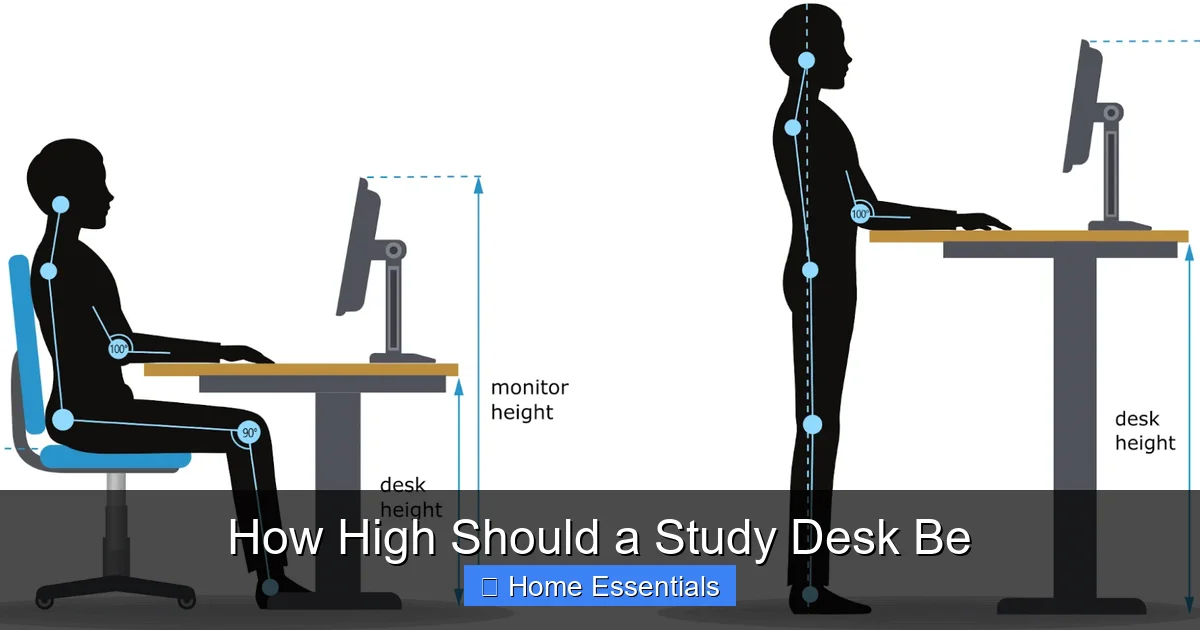
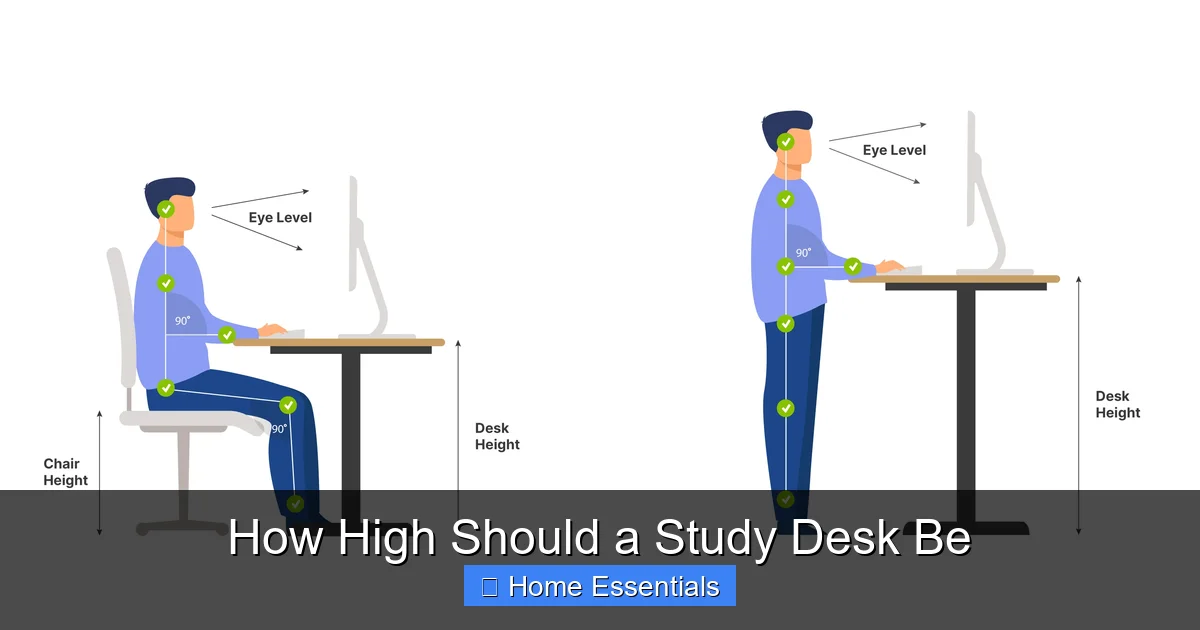
The cornerstone of proper desk ergonomics is the 90-degree angle. When you sit at your desk with your arms resting on the keyboard:
- Your upper arms should hang naturally close to your body.
- Your forearms should be parallel to the floor or angled slightly downward.
- Your elbows should be bent at approximately a 90-degree angle.
- Your knees should also be at a 90-degree angle, with your feet flat on the floor or on a footrest.
If your desk is too high, you’ll raise your shoulders (shrugging) to reach the keyboard, creating tension in your neck and trapezius muscles. Your wrists may also bend upward (extension), compressing nerves. If your desk is too low, you’ll hunch forward, rounding your shoulders and straining your upper back and neck. Your wrists may bend downward (flexion), again putting pressure on soft tissues.
Wrist and Forearm Neutrality
Your wrists should be in a straight, neutral alignment with your forearms. Imagine a straight line from your elbow through your wrist to the knuckles of your middle fingers. Any sharp bend up or down increases pressure on the carpal tunnel, a common pathway for carpal tunnel syndrome. This is why the height of your keyboard tray (if you use one) is just as important as the main desk surface.
The Visual Line: Monitor Placement
While not directly about desk height, your desk’s depth and height dictate where your monitor can sit. The top third of your screen should be at or slightly below eye level, and you should be an arm’s length away. A desk that’s too shallow or too high can force you into awkward neck positions to see your screen, negating all the good work you’ve done with your keyboard position.
Standard Desk Heights: What’s Available?
Now that we know the goal, let’s look at the starting line. Most factory-made desks come in a few standard heights. Understanding these helps you know what you’re working with.

Visual guide about How High Should a Study Desk Be
Image source: brother.com.au
The Traditional Fixed Desk: 28-30 Inches (71-76 cm)
This is the most common height for a standard writing or computer desk. It’s designed for an “average” adult male height (historically around 5’10” or 178 cm) when paired with a typical office chair (about 16-19 inches seat height). For many people, this range will be close but not perfect. If you are significantly shorter or taller than 5’10”, this fixed height will likely require compensation through your chair or other accessories.
Standing Desk Converters and Fixed-Height Tables
Standing desk converters (units placed on top of an existing desk) have their own height ranges, usually starting from about 4-6 inches of lift up to 16-20 inches. It’s critical to check the maximum and minimum heights to ensure your sitting and standing postures will both be ergonomic. Some fixed-height dining or console tables used as desks can be as low as 26 inches or as high as 32 inches, which falls far outside the ideal range for most people.
Adjustable Height Desks: The Best Solution
Sit-stand desks, whether electric or manual (crank), offer the most flexibility. Their ranges vary widely. A good electric desk should have a sitting range of roughly 22-28 inches and a standing range of roughly 28-48 inches. This allows both a petite person (around 5’0”) and a tall person (around 6’6”) to find their perfect seated and standing heights. The ability to change height throughout the day is also a major health benefit, combating the dangers of prolonged sitting.
To give you a clearer picture, here’s a general guide correlating user height to ideal seated desk height. Remember, these are estimates based on average body proportions.
- For users ~5’0″ to 5’4″ (152-163 cm): Ideal seated desk height is often 22-25 inches (56-63.5 cm).
- For users ~5’5″ to 5’9″ (165-175 cm): Ideal seated desk height is often 25-28 inches (63.5-71 cm).
- For users ~5’10” to 6’2″ (178-188 cm): Ideal seated desk height is often 28-31 inches (71-79 cm).
- For users 6’3″ and above (191 cm+): Ideal seated desk height is often 31+ inches (79 cm+).
If your standard 29-inch desk doesn’t fit your range, don’t panic. There are several effective fixes.
How to Measure and Adjust for Your Perfect Height
Finding your number is a simple process of measurement and adjustment.
Visual guide about How High Should a Study Desk Be
Image source: cdn.inchcalculator.com
The Simple Measurement Test
1. Sit in your chair with your back against the backrest and your feet flat on the floor (or on a footrest if they don’t reach).
2. Let your arms hang naturally at your sides.
3. Bend your elbows to a 90-degree angle, as if you were about to type.
4. Measure the distance from the floor to the bottom of your raised forearm (the elbow side). This measurement, in inches or centimeters, is your ideal seated desk height.
Let’s say that measurement is 26 inches. If your desk is 29 inches, your forearms will be angled upward, raising your shoulders. You need to lower your effective working surface by 3 inches.
Adjustment Strategies When Your Desk is Too High
This is the more common problem with standard desks.
- Raise Your Chair: This is the first and easiest step. Adjust your chair height until your feet are flat and your elbows are at 90 degrees. Caution: If raising your chair causes your feet to dangle, you must use a footrest. Dangling feet increases pressure on the underside of your thighs and disrupts circulation.
- Use a Keyboard Tray: A well-installed, adjustable keyboard tray allows you to lower the keyboard and mouse to the correct height independently of the desk surface. This is an excellent solution if you cannot lower the desk itself.
- Install a Desk Riser or Leg Extenders: For a fixed-height desk that’s too low (less common), you can add sturdy blocks or commercial risers under the desk legs to increase its height.
Adjustment Strategies When Your Desk is Too Low
This is trickier and less common with standard desks.
- Lower Your Chair: Obviously, adjust down first.
- Place Sturdy Boards or Blocks Under Your Chair Legs: If your chair doesn’t go low enough, you can safely raise the floor under it with solid blocks. Ensure they are stable and won’t slip.
- Get a Shorter Chair: If you are consistently struggling, a chair with a lower minimum seat height might be the answer.
- Consider a New Desk: If the desk is significantly too low (e.g., a 26-inch table for a tall person), major modifications become unsafe or ugly. Investing in an adjustable-height desk is the most practical long-term fix.
Special Considerations: Kids, Teens, and Shared Spaces
A child’s study desk is not a place to “grow into.” Using a desk that’s too high or too low for their current size can negatively impact their developing posture and spine.
Visual guide about How High Should a Study Desk Be
Image source: officefurniturescene.co.uk
Growth Requires Flexibility
A desk that fits a 7-year-old will be unusable for the same child at 13. For children and teens, an adjustable-height desk is not a luxury; it’s a necessity. Look for desks with a wide height range and easy-to-use adjustment mechanisms (crank or electric). Alternatively, be prepared to replace a fixed-height desk every 2-3 years as they grow.
The “Shared Desk” Dilemma
In a household or office where multiple people use the same desk, a fixed height is a recipe for compromise and poor ergonomics for at least one user. An adjustable sit-stand desk is the clear winner here. Each user can quickly set the height to their personal preference at the start of their session, ensuring everyone works comfortably and safely.
The Perfect Pair: Desk Height and Chair Height
You cannot talk about one without the other. They are two halves of a system.
Finding the Chair-Desk Harmony
Once you have your ideal desk height number (from the measurement test), your chair height is dictated by it. Your chair’s seat height must be set so that with your feet flat, your thighs are horizontal (or slightly sloping down toward the knees), and your elbows hit that 90-degree angle at the desk. The gap between the front of your seat and the back of your knees should be about the width of your fist (2-3 inches) to avoid pressure on the popliteal fold.
Lumbar Support and Armrests
With your seat height correct, ensure your chair’s lumbar support aligns with the natural inward curve of your lower back. If your desk has a built-in or attached keyboard tray, your armrests (if used) should allow your elbows to rest at 90 degrees without your shoulders being raised. Sometimes, this means you may need to remove armrests or adjust them downward if they interfere with getting close enough to the desk.
Common Mistakes and How to Avoid Them
Even with the right numbers, people often sabotage their own ergonomics.
Mistake 1: Using the Dining Table “Because It’s Bigger”
Dining tables are often 29-31 inches high, designed for eating with a plate, not for typing. They are frequently too high for comfortable computer work, especially for average or shorter individuals. If you must use one, you will almost certainly need a keyboard tray and possibly a footrest.
Mistake 2: The “Book Under the Monitor” Solution
If your desk is too high, you might be tempted to raise your monitor with a stack of books. This is a temporary fix for screen height but does nothing for your wrist and arm position. You still have to reach up to type. Focus on fixing the keyboard/mouse height first.
Mistake 3: Ignoring the Footrest
If your feet don’t flatly touch the floor after adjusting your chair and desk, you need a footrest. A stable, angled footrest takes pressure off your thighs, improves circulation, and helps maintain pelvic alignment. A wobbly stack of papers does not count.
Mistake 4: Forgetting About Movement
No desk height, no matter how perfect, can compensate for sitting motionless for 8 hours. The best setup is an adjustable desk that allows you to alternate between sitting and standing every 30-60 minutes. Even with a fixed desk, set a timer to stand up, stretch, and walk for a few minutes every hour.
Maintaining your workspace also contributes to a healthy environment. A clean desk can improve focus and reduce allergens. For tips on keeping your study area dust-free, you might find guidance on how to use a microfiber cloth very useful, as it’s ideal for wiping down surfaces without scratching. Proper cleaning techniques for your desk and accessories are part of overall workspace wellness.
Conclusion: Your Health is in Your Hands (and on Your Desk)
The question “How high should a study desk be?” doesn’t have a single answer. The answer is: the height that allows your body to be in a neutral, relaxed posture while you work. For most adults, that ideal sits somewhere between 22 and 31 inches, but your personal measurement is the only one that matters. Stop accepting daily aches and pains as “just part of studying.” Take the 30 seconds to do the elbow measurement test. If your desk doesn’t match, explore the adjustment strategies—raise your chair, get a keyboard tray, use a footrest, or seriously consider an adjustable-height desk. Your future self, free from chronic back pain and carpal tunnel, will thank you. Your productivity will soar, not because you worked harder, but because you worked smarter—starting with the very surface you work on.
Frequently Asked Questions
What is the standard height for a study desk?
The standard, fixed height for a desk is typically 28-30 inches (71-76 cm). This is designed for an average-height adult but is merely a starting point. Your ideal height depends entirely on your individual body proportions and chair height.
How do I know if my desk is too high or too low?
Sit in your chair with your feet flat. Your elbows should be at a 90-degree angle when your hands are on your keyboard/mouse. If your shoulders are hunched up, your desk is too high. If you’re leaning forward or your wrists are bent sharply down, your desk is likely too low. Your feet should also be flat; if they dangle, your chair is too high relative to the desk.
Can I use a regular dining table as a study desk?
You can, but dining tables are often 29-31 inches high, which is too high for many people for prolonged computer work. You will likely need a keyboard tray to lower your typing surface and a footrest if your feet don’t reach the floor comfortably. An adjustable desk is a far better long-term solution.
What if my feet don’t touch the floor after adjusting my desk and chair?
You must use a stable footrest. Dangling feet increases pressure on your thighs, reduces circulation, and leads to poor posture and discomfort. A proper footrest allows you to maintain the 90-degree knee angle and stable pelvic position.
Is a standing desk better than a sitting desk?
The best option is a sit-stand adjustable desk. Prolonged sitting is harmful, but standing all day has its own issues. The ability to alternate between sitting and standing postures every 30-60 minutes is ideal for circulation, energy levels, and long-term musculoskeletal health. A fixed-height desk only offers one posture.
How often should I check my child’s desk height?
Children grow quickly. You should reassess your child’s desk and chair fit every 6 months. Their elbows should still be at 90 degrees, and their feet should be flat. An adjustable-height desk is highly recommended for kids and teens to accommodate their growth without needing frequent furniture replacements.