What Light Bulb for Desk Lamp
Choosing the correct light bulb for your desk lamp is crucial for eye comfort, productivity, and creating the right atmosphere. It’s not just about picking any bulb; you need to consider the bulb type (LED, halogen, incandescent), brightness measured in lumens, color temperature in Kelvins, and the physical base and shape that fits your lamp. Making an informed choice reduces eye strain, saves energy, and ensures your task lighting actually works for you.
Key Takeaways
- Bulb Type Matters Most: LED bulbs are the modern standard for desk lamps, offering superior energy efficiency, long life, and better light quality compared to old incandescent or halogen bulbs.
- Brightness is About Lumens, Not Watts: Forget wattage for brightness. For a desk, aim for 300-500 lumens for general tasks and up to 800+ lumens for detailed work like drafting or electronics repair.
- Color Temperature Defines the Mood: Measured in Kelvins (K). Choose 2700K-3000K for warm, relaxing light; 4000K-5000K for neutral, focused daylight; avoid very cool 6500K+ for desks as it can be harsh.
- Check Your Lamp’s Base & Shape: The most common desk lamp base is E26 (medium screw-in). Ensure the bulb’s shape (A-series, globe, reflector) fits your lamp’s shade and housing without causing glare or overheating.
- Consider Special Features: Dimmability is key for adjustable task lighting. If you want smart features, ensure you buy a compatible smart bulb and understand its setup requirements, which you can learn about in our guide on what is a smart light bulb.
- Prioritize Eye Comfort: Look for bulbs with a high CRI (Color Rendering Index) of 90+ for accurate color perception, and ensure your lamp has adequate shielding to prevent direct glare into your eyes.
📑 Table of Contents
- Why Your Desk Lamp Bulb Choice is a Bigger Deal Than You Think
- Demystifying Bulb Types: What’s Actually Available?
- Cracking the Code: Lumens, Watts, and Brightness
- Setting the Right Tone: Decoding Color Temperature (Kelvins)
- Size and Fit: Bulb Bases, Shapes, and Your Lamp
- Beyond the Basics: Special Features and Smart Considerations
- Putting It All Together: Your Step-by-Step Selection Guide
- Conclusion: Light Up Your Workspace the Right Way
Why Your Desk Lamp Bulb Choice is a Bigger Deal Than You Think
You plug in your trusty old desk lamp, twist in a bulb from the junk drawer, and flick the switch. It lights up. Job done, right? Not so fast. That simple act of choosing a light bulb for your desk lamp might be one of the most overlooked factors in your daily comfort, productivity, and even long-term eye health. The right bulb transforms a mediocre lamp into a precision tool that reduces eye strain, boosts focus, and makes your workspace a pleasure to be in. The wrong one? It can leave you squinting, experiencing headaches after an hour of work, and feeling perpetually fatigued. This guide will cut through the confusing jargon on bulb packaging—lumens, Kelvins, watts, CRI—and give you a clear, actionable roadmap to find the perfect light bulb for your specific desk lamp and tasks. Let’s shed some light on the subject.
Demystifying Bulb Types: What’s Actually Available?
Gone are the days when your only choice was a 60-watt soft white incandescent. Today’s lighting aisle is a jungle of technologies. Understanding the core differences is your first step.
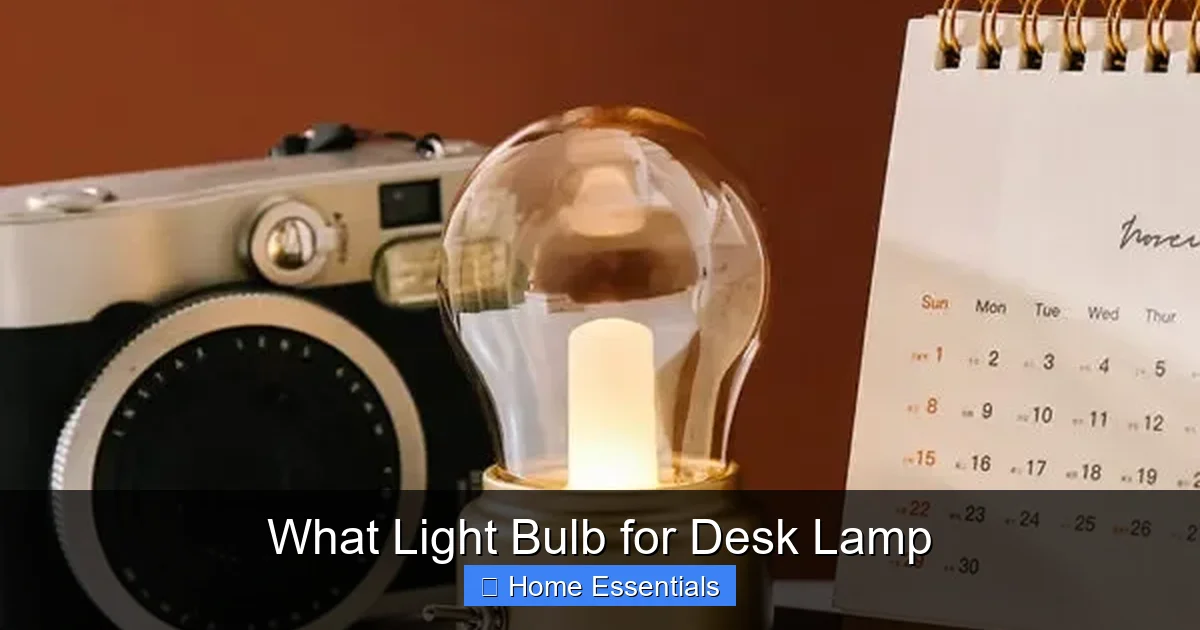
Visual guide about What Light Bulb for Desk Lamp
Image source: i0.wp.com
LED: The Undisputed Champion for Desk Lamps
Light Emitting Diodes (LEDs) are the default recommendation for virtually all modern desk lighting. Why? They are incredibly energy-efficient, using about 75-80% less electricity than an equivalent incandescent bulb to produce the same light output. This translates to pennies on the electricity bill and a dramatically reduced environmental footprint. More importantly for your desk, LEDs produce very little heat, so you won’t have a hot bulb baking your forehead during long work sessions. They also have an exceptionally long lifespan, often rated for 15,000 to 25,000 hours or more—meaning you might change your desk bulb once every decade. Modern LEDs offer excellent color quality and are available in every conceivable color temperature and brightness level.
Pro Tip: When buying an LED, look for the Energy Star label. It guarantees the bulb meets strict efficiency and performance standards, and it will often list the equivalent incandescent wattage (e.g., “60W equivalent”) for easy reference.
Incandescent & Halogen: The fading classics
You might still see these on shelves. Traditional incandescent bulbs work by heating a tiny filament until it glows. They produce a beautifully warm, continuous spectrum of light that many find easy on the eyes. However, they are energy hogs, waste about 90% of their energy as heat, and have very short lifespans (1,000-2,000 hours). Halogen bulbs are a more efficient, hotter-burning subtype of incandescent. They’re slightly better but still fall far short of LEDs in efficiency and lifespan. While their light quality is often praised, the operating cost and heat make them a poor, outdated choice for a desk lamp used daily. If you have a vintage lamp with a specific bulb requirement, consider an LED retrofit bulb that mimics the warm glow of an incandescent.
CFL: The Middle Child That’s Losing Relevance
Compact Fluorescent Lamps (CFLs) were the bridge between incandescents and LEDs. They use about 70% less energy than incandescents and last longer (8,000-10,000 hours). Their major drawback for desk use is their light quality. Many CFLs have a low CRI, meaning colors look dull or unnatural. They also can take a moment to warm up to full brightness and contain a tiny amount of mercury, requiring careful disposal. For a task-oriented space like a desk where you want instant, high-quality light, CFLs are generally outclassed by modern LEDs.
Cracking the Code: Lumens, Watts, and Brightness
This is the most critical—and most misunderstood—part of choosing a bulb. Forget about watts. Watts measure energy consumption, not light output. A 10-watt LED can produce the same light as a 60-watt incandescent. The true measure of brightness is lumens (lm).
Visual guide about What Light Bulb for Desk Lamp
Image source: microless.com
How Many Lumens Does Your Desk Really Need?
There’s no one-size-fits-all answer, as it depends entirely on your task. Here’s a practical breakdown:
- General Computer Work, Reading, Writing: 300-500 lumens. This is sufficient for illuminating your keyboard and a book without causing glare on your screen. A standard 60W-equivalent LED (around 800 lumens) is often too bright for close-up screen work unless dimmed or shaded.
- Detailed Work: 500-800+ lumens. If you’re doing intricate tasks like electronics soldering, jewelry making, detailed drawing, or sewing, you need more focused, powerful light. You might need a bulb in the 800-1100 lumen range (100W equivalent) or use a lamp with multiple bulbs or an adjustable arm to direct light precisely.
- Ambient/Accent Lighting: If your desk lamp is more for atmosphere than primary task lighting, you might go as low as 100-200 lumens.
Practical Test: Start with a 400-500 lumen bulb. Sit at your desk. Can you comfortably see your keyboard and reading material without squinting or feeling the light is too harsh? If it’s dim, go up a lumen level. If it’s glaring, go down or adjust your lamp’s position.
The Wattage Equivalent Trap
Bulb packaging still shows “60W Equivalent” for legacy reasons. This is a helpful hint but can be misleading. Two different “60W equivalent” LED bulbs from different brands might have slightly different lumen outputs (e.g., 750 lm vs. 840 lm). Always check the actual lumens number on the box for precision.
Setting the Right Tone: Decoding Color Temperature (Kelvins)
Color temperature describes the “warmth” or “coolness” of white light, measured in Kelvins (K). It has a profound psychological and physiological effect.
Visual guide about What Light Bulb for Desk Lamp
Image source: odditymall.com
The Kelvin Scale for Your Desk
- 2700K-3000K (Warm White): This is the color of traditional incandescent bulbs and sunset light. It’s cozy, relaxing, and easy on the eyes for evening reading. However, for focused, analytical desk work during the day, it can be too yellow and slightly sedating, potentially making you feel drowsy.
- 3500K-4000K (Neutral/Cool White): This is the sweet spot for most desk tasks. It mimics bright, overcast daylight. It’s alert, clean, and provides excellent contrast for reading text and seeing details on a computer screen without the harsh blue edge of very cool light. This is the color temperature I recommend for 90% of home office desks.
- 5000K-6500K (Daylight/Cool Blue): This is the color of high-noon sun. It’s extremely bright, blue-tinted, and maximizes alertness and perceived brightness. It’s excellent for tasks requiring intense focus and color accuracy (e.g., graphic design, photo editing, makeup application). However, prolonged exposure can cause eye fatigue and headaches for many people. Use it sparingly or ensure your lamp has a diffuser.
My Recommendation: Buy a 4000K bulb for your main desk lamp. It’s the most versatile and comfortable for all-day use. If you have a secondary task light for detailed work, a 5000K bulb there can be useful.
Size and Fit: Bulb Bases, Shapes, and Your Lamp
You could have the perfect lumens and Kelvin bulb, but it’s useless if it doesn’t fit your lamp. This is often the simplest thing to check but the most common point of failure.
Identifying the Base: The Screw-In Standard
The vast majority of desk lamps use the standard E26 base (also called “medium” or “Edison” base). This is the large, familiar screw-in base. A smaller E12 base (“candelabra”) is common in decorative lamps, chandeliers, and some vintage-style desk lamps. Look at the existing bulb in your lamp. The metal threading is the base. Count the width in millimeters (the “E” number refers to the diameter in mm). If it’s about 26mm across, it’s an E26. If it’s about 12mm, it’s an E12. There’s no adapter—you must buy a bulb with the matching base.
Bulb Shape (A-Series, Globe, etc.) and Lamp Compatibility
The shape (A19, A21, G25, BR30, etc.) must fit within your lamp’s shade or housing.
- A-Series (A15, A19, A21): The classic “light bulb” shape. The number indicates the size (A19 is most common for table/desk lamps). Ensure the bulb isn’t too long to touch the inner surface of your lamp shade, which can cause heat damage (less of an issue with LEDs) or create a hot spot and glare.
- Globe (G): A spherical bulb. Often used in pendants or exposed-fixture lamps. Make sure your lamp’s shade opening is large enough.
- Reflector/Flood (BR, PAR): These have a built-in reflector to direct light forward in a focused beam. They are common in recessed cans but sometimes used in desk lamps with a directional focus. Check if your lamp’s socket is designed for this shape.
Action Step: Remove your old bulb. Look at the base code (E26) printed on the metal or glass. Then, look at the shape code (e.g., A19). Buy a new bulb with the same base and a similar or smaller shape size to guarantee fit.
Beyond the Basics: Special Features and Smart Considerations
Once you’ve nailed down type, lumens, Kelvins, and fit, you can optimize further.
Dimmability: A Must-Have for Flexibility
Your desk tasks change. Sometimes you need full power for a complex document. Other times, you want a soft glow for a video call or late-night email check. A dimmable bulb paired with a compatible dimmer switch on your lamp cord or base is a game-changer. Crucially, not all LEDs are dimmable. You must buy a bulb explicitly labeled “dimmable.” Furthermore, older or cheap dimmer switches (especially leading-edge/triac types) can cause LED bulbs to buzz, flicker, or not dim properly. If you have issues, you might need to replace the dimmer switch with one rated for LEDs. Flickering is a common frustration; our article on why is smart bulb flickering explains the causes, which often apply to standard dimmable LEDs too.
High CRI for True Colors
CRI (Color Rendering Index) measures how accurately a light source reveals the true colors of objects compared to natural light, on a scale of 0 to 100. For a desk, especially if you work with color—graphic design, clothing, art, food presentation, or even just want your skin tones to look natural—a CRI of 90 or above is ideal. Most good-quality LEDs will have a CRI of 80-85, which is acceptable. High-CRI bulbs are a bit more niche and sometimes cost more, but they are worth it for color-critical work. The CRI is usually listed on the bulb packaging or spec sheet.
Smart Bulbs: The Connected Desk
What if you could control your desk lamp’s brightness and color from your phone, set schedules, or sync it with your circadian rhythm? Smart bulbs make this possible. They are LED bulbs with built-in Wi-Fi or Bluetooth radios. For a desk lamp, this means you could warm the light in the evening without getting up, or have it brighten gradually in the morning. However, they come with considerations: they are more expensive, require a stable Wi-Fi network, and need setup via an app. They also typically need constant power (they can’t be switched off at the wall/outlet, as that cuts power and breaks their connection). If you’re intrigued, research compatibility with your smart home system (Alexa, Google Home, Apple HomeKit) first. Our guide on what smart bulbs work with Alexa is a great starting point.
Putting It All Together: Your Step-by-Step Selection Guide
Let’s make this actionable. Here is your checklist for buying the next bulb for your desk lamp:
- Physically Inspect Your Lamp: Note the existing bulb’s base (E26? E12?) and approximate shape/size. If the old bulb is gone, look inside the socket for markings.
- Define Your Primary Task: Is it computer work? Reading physical books? Detailed crafting? This dictates your lumen target.
- Choose Your Color Temperature: For most, 4000K is the balanced, all-day winner. Opt for 2700K only if you want a very relaxed, warm feel, or 5000K if you need maximum alertness for short periods.
- Select a Dimmable LED: Unless your lamp has no dimmer and you never want one, choose a dimmable LED bulb for future flexibility.
- Check the Specs for CRI (Optional but Recommended): If color accuracy matters, find a bulb with CRI 90+.
- Buy a Quality Brand: Stick with reputable lighting brands (Philips, GE, Sylvania, Feit, Cree, etc.) or well-reviewed generic brands on Amazon. Cheap, no-name LEDs can have poor color quality, flicker, and short lifespans, negating all savings.
- Consider a Smart Bulb (If it Fits Your Lifestyle): If you love tech and convenience, and your lamp is always on, a smart bulb can be a fantastic upgrade. Just ensure it’s dimmable if you want that feature, as not all smart bulbs dim smoothly on standard hardware.
Final Pro-Tip: Don’t put a bulb with a lumen rating far higher than you need into a small, enclosed desk lamp shade. The light can be overwhelming, cause glare, and even potentially overheat the fixture (though LEDs run cool, concentrated heat in a tiny space isn’t ideal). When in doubt, start conservative (400-500 lumens) and increase if needed.
Conclusion: Light Up Your Workspace the Right Way
The humble desk lamp bulb is a powerhouse of influence. It controls the clarity of your vision, the comfort of your posture, and the energy of your environment. By moving beyond the wattage and understanding lumens for brightness and Kelvins for mood, you take control of your visual experience. Always start with the physical constraints of your lamp—base and shape—then layer in the specifications: a dimmable LED around 4000K and 400-500 lumens is a phenomenal, all-around starting point for the modern home office. If you need more punch for detail work, step up the lumens. If you live in a smart home, explore the world of connected bulbs for unparalleled convenience. Investing two minutes in choosing the right bulb pays dividends every single day in reduced eye fatigue, better mood, and a more enjoyable, productive workspace. Your eyes will thank you.
Frequently Asked Questions
Can I use a higher wattage equivalent LED bulb in my desk lamp?
Yes, you can use a higher equivalent wattage (e.g., a 100W equivalent instead of 60W) as long as the physical bulb fits and your lamp’s socket and wiring are rated for the actual wattage (which for LEDs is very low, so it’s almost always safe). The real limit is your comfort—too many lumens can cause glare. Start with a moderate brightness and adjust.
What is the best color temperature for a home office desk?
For most people, a neutral white light between 4000K and 5000K is ideal. It promotes alertness and provides clear, shadow-minimizing light for reading and screen work without the harsh, blue-tinged edge of very cool light (6500K+), which can cause eye strain over time.
My LED bulb buzzes or flickers when I dim it. Is it defective?
Not necessarily. This is often a compatibility issue between the LED bulb and an older dimmer switch designed for incandescent bulbs. You may need to replace your lamp’s dimmer with one specifically rated for LED dimming. Also, ensure you bought a bulb that is explicitly labeled “dimmable.”
Should I get a smart bulb for my simple desk lamp?
Only if you will use its smart features regularly. A smart bulb is overkill if you just want a steady light. But if you want to adjust color/brightness from your chair, set schedules, or integrate with other smart home devices, it’s a great upgrade. Just remember it must stay powered on (not switched off at the wall) to remain connected.
How do I know if my lamp takes an E26 or E12 bulb?
Look at the metal threading on your existing bulb. An E26 (standard) base is about 1 inch (26mm) in diameter. An E12 (candelabra) base is about ½ inch (12mm) in diameter. You can also often find the base size printed on the bulb’s metal or glass base (e.g., “E26” or “E12”).
What does CRI mean, and do I need a high CRI for my desk?
CRI (Color Rendering Index) measures how accurately a light shows colors, from 0-100. A CRI above 80 is decent. For tasks where true color matters—design, art, clothing, food, or just wanting natural-looking skin tones—look for a bulb with a CRI of 90 or higher. For general computer work, a standard 80+ CRI is usually sufficient.