Air Purifying Desk Plants
Air purifying desk plants are a simple, effective way to improve your workspace’s air quality and overall well-being. These low-maintenance plants actively remove common toxins like formaldehyde and benzene, reduce stress, and can even enhance focus and productivity. Adding just one or two to your desk or nearby shelf can transform your immediate environment, creating a healthier, more pleasant place to work without any complicated setup.
Hey there! Let’s talk about the air you’re breathing right now. Whether you’re in a home office, a corporate cubicle, or a cozy corner of a coffee shop, indoor air can be surprisingly polluted. Think about it: furniture, electronics, cleaning supplies, and even that new carpet off-gas volatile organic compounds (VOCs). We spend up to 90% of our time indoors, so the quality of that air matters—a lot—for our energy, focus, and long-term health. What if I told you the solution could be sitting right on your desk? Welcome to the world of air purifying desk plants. These aren’t just pretty decor; they’re hardworking, living air filters that can transform your personal workspace into a cleaner, calmer, and more inspiring place. And the best part? You don’t need a green thumb to make it work.
Forget complicated air purifiers with noisy fans and expensive filters. We’re talking about bringing a piece of nature into your immediate vicinity. A single plant on your desk or a small cluster on a nearby shelf can make a measurable difference. This isn’t just wellness folklore; it’s backed by serious science. In this guide, we’ll dive deep into how these leafy allies work, introduce you to the absolute best varieties for desk life (spoiler: they’re tough as nails), and give you the no-fuss care tips you need to keep them thriving. By the end, you’ll know exactly which air purifying desk plants are perfect for your space and how to welcome them into your daily routine. Let’s get growing!
Key Takeaways
- Natural Air Filtration: Specific desk plants absorb volatile organic compounds (VOCs) like formaldehyde, benzene, and trichloroethylene through their leaves and root systems, actively cleaning your immediate airspace.
- Mental Health Boost: The presence of greenery reduces stress, lowers anxiety, and can improve mood, making your workspace feel more calming and supportive.
- Low-Maintenance Champions: Many top air-purifying varieties, like the Snake Plant and ZZ Plant, thrive on neglect, requiring minimal watering and tolerating low-light office conditions.
- Productivity & Focus: Studies suggest that plants in workspaces can increase concentration, creativity, and task performance by up to 15%.
- Humidity & Noise: Through transpiration, these plants naturally increase humidity levels, combating dry office air. Their leaves can also help absorb and diffuse background noise.
- NASA-Validated: The list of effective air-purifying plants is based on the famous NASA Clean Air Study, providing scientific backing for their toxin-removing capabilities.
- Aesthetic Upgrade: Beyond function, they add a touch of nature, softness, and personal style to an otherwise sterile desk or cubicle.
📑 Table of Contents
How Do Air Purifying Desk Plants Work?
It’s easy to think of plants as just sitting there, photosynthesizing quietly. But when it comes to cleaning air, they’re active participants in a fascinating micro-ecosystem. The process happens in a few key ways, turning your desk into a mini-biome of purification.
The Power of Phytoremediation
Phytoremediation is a fancy word for plants cleaning contaminated environments. For air purifying desk plants, this primarily involves their leaves and the soil microbiome. Air pollutants, including the infamous VOCs, are drawn into the plant through tiny pores on the underside of leaves called stomata. Once inside, some toxins are broken down by plant enzymes or used as nutrients. Others are transported down to the root zone, where beneficial microbes in the soil feast on and metabolize them, rendering them harmless. It’s a beautiful, natural partnership between the plant and its soil ecosystem.
Beyond Toxin Absorption: Humidity and Particulates
The benefits don’t stop with chemicals. Through a process called transpiration, plants release water vapor from their leaves. This naturally increases humidity around your desk, which is a huge plus in dry, air-conditioned or heated offices. Proper humidity can reduce dry skin, irritated sinuses, and even help your respiratory system trap and expel dust particles more effectively. Plus, the physical surfaces of leaves can trap dust and particulate matter from the air, preventing them from circulating and settling on your keyboard.
The NASA Clean Air Study: A Landmark Discovery
You can’t discuss this topic without mentioning the 1989 NASA Clean Air Study. Conducted by Dr. B.C. Wolverton and his team, this research aimed to find ways to purify air in sealed space stations. The results were groundbreaking. They identified dozens of common houseplants that were highly effective at removing benzene, formaldehyde, trichloroethylene, xylene, and ammonia from the air. While the study’s conditions (sealed chambers) were more extreme than a typical office, it provided the definitive scientific list that all air purifying desk plants recommendations are still based on today. It proved that plants are more than just decorative; they’re functional bio-filters.
Top 6 Air Purifying Desk Plants for Your Workspace
Not all plants are created equal for the desk environment. You need species that are tolerant of inconsistent watering, variable light (often low), and confined spaces. They must be non-toxic if you have pets or small children, or at least clearly labeled. Here are the top six champions, chosen for their air-purifying prowess, resilience, and desk-friendly size.
Visual guide about Air Purifying Desk Plants
Image source: theorganicgoatlady.com
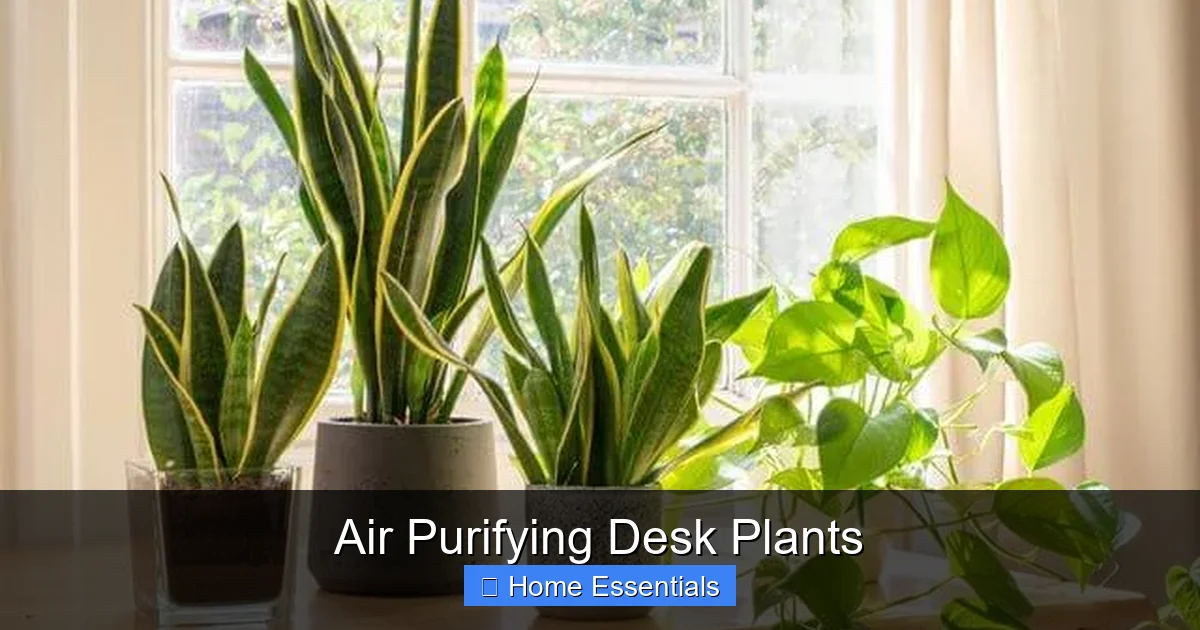
1. Snake Plant (Sansevieria trifasciata)
Also known as “Mother-in-Law’s Tongue,” the Snake Plant is the undisputed heavyweight champion of low-maintenance air purifying desk plants. It’s nearly indestructible. It prefers to be ignored, thriving on neglect. It’s a powerful absorber of formaldehyde, benzene, xylene, and trichloroethylene. Its tall, architectural leaves shoot straight up, making it perfect for tight corners behind your monitor. It’s one of the few plants that performs its unique form of photosynthesis at night, releasing oxygen while you sleep—a nice bonus if it’s in your home office.
Desk Tip: Choose a dwarf variety like ‘Hahnii’ or ‘Cylindrica’ for a compact footprint. Place it in a pot with excellent drainage and forget about it. Water only when the soil is completely bone dry, maybe once a month in winter.
2. ZZ Plant (Zamioculcas zamiifolia)
The ZZ Plant is another titan of survival. With its glossy, dark green, feather-like leaflets on graceful stems, it looks elegant but is tougher than a $2 steak. It’s a champion at removing toluene and xylene from the air. It stores water in its potato-like rhizomes (underground stems), so it can go weeks without a drink. It tolerates low light, fluorescent light, and even the dark corners of an office with surprising grace. If you’re a notorious plant killer, start here.
Desk Tip: Its slow growth means it won’t quickly outgrow your desk. A small 4-inch pot is perfect. The biggest mistake is overwatering—let it dry out thoroughly between waterings. Wipe its leaves occasionally to keep them shiny and maximize gas exchange.
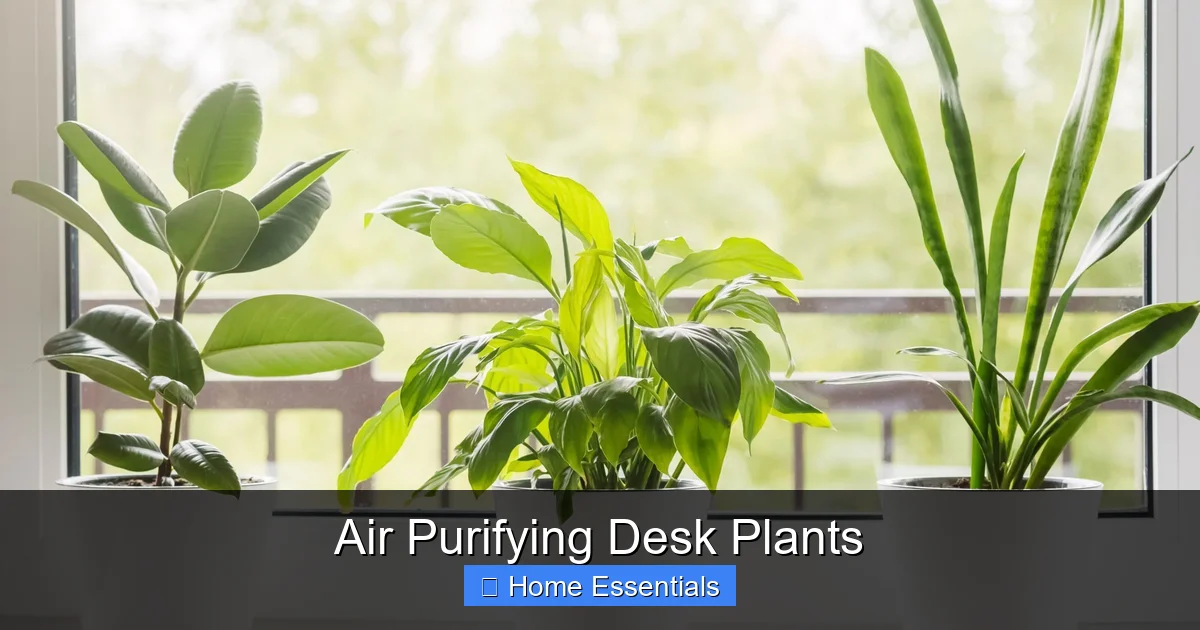
3. Peace Lily (Spathiphyllum spp.)
Ah, the Peace Lily. It’s not a true lily, but its elegant white “flowers” (actually modified leaves called spathes) are a symbol of serenity. It’s a powerhouse remover of ammonia, formaldehyde, benzene, and trichloroethylene. It’s also a moisture lover, so it can help humidify your immediate air. The Peace Lily is famously communicative: when it’s thirsty, its leaves dramatically droop. It perks right back up after a drink. It prefers medium to low light but will still bloom with a bit more brightness.
Desk Tip: Keep it on a side table or a filing cabinet near your desk, not directly on your keyboard where water might drip. It likes consistent moisture but not soggy roots. Important: Peace Lilies are toxic to pets if ingested, so keep them out of reach of cats and dogs.
4. Golden Pothos / Devil’s Ivy (Epipremnum aureum)
This fast-growing vine is the ultimate workhorse. It’s incredibly effective at filtering formaldehyde, benzene, xylene, and carbon monoxide. Its heart-shaped leaves with golden variegation trail beautifully, making it ideal for a high shelf, a bookcase, or a hanging pot beside your desk. It’s almost impossible to kill and will grow in almost any light condition, from low to bright indirect. It’s also one of the easiest plants to propagate—just snip a stem and pop it in water.
Desk Tip: Train its vines with small clips to a trellis or a pencil holder for a tidy look. Prune it back to keep it bushy and compact. Water when the top inch of soil is dry. It’s a great “starter plant” for a new desk.
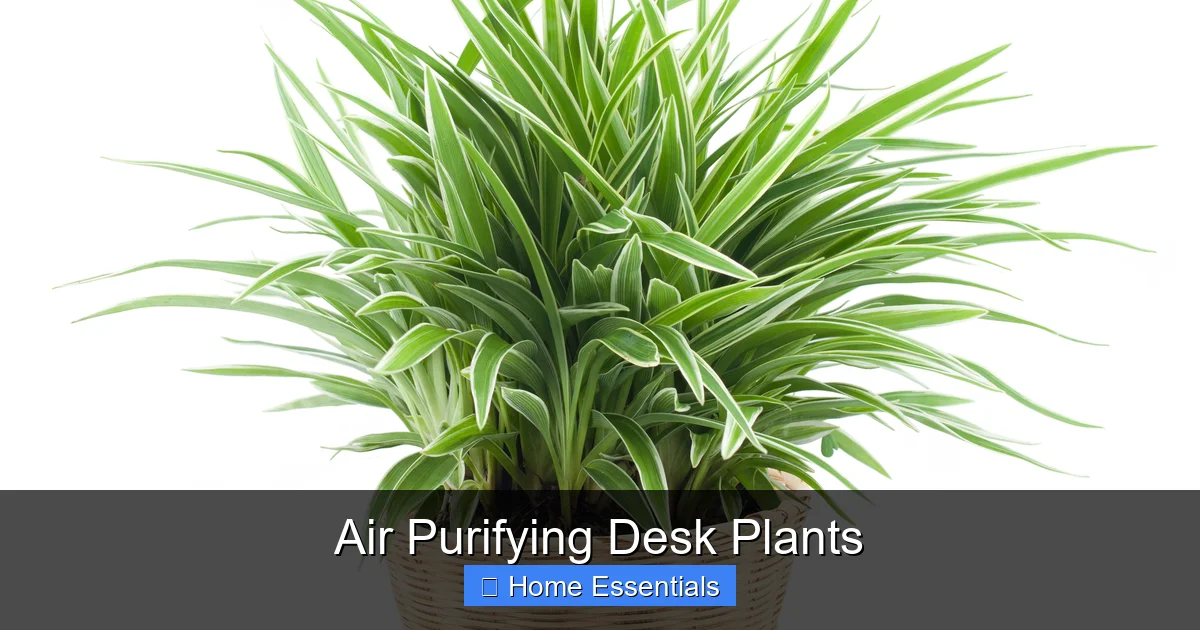
5. Spider Plant (Chlorophytum comosum)
The Spider Plant is a classic for a reason. It’s charming, prolific, and a fantastic air purifier, tackling formaldehyde and xylene efficiently. Its long, slender leaves arch outward, and it constantly produces little “babies” or plantlets on dangling stems, which is just fun to watch. It’s non-toxic and safe for all households. It thrives in bright, indirect light but is very adaptable. It’s also known to be a great “bioindicator”—brown leaf tips can signal fluoride sensitivity or underwatering.
Desk Tip: Hang it in a macramé hanger near a window to keep its trailing babies out of your way. It likes consistent moisture but is forgiving. Snip off the brown tips if they bother you, and pot the baby plants to share with friends.
6. Aloe Vera (Aloe barbadensis miller)
Aloe is a dual-purpose wonder. It’s on NASA’s list for removing formaldehyde. Plus, its succulent gel is a natural remedy for minor burns and skin irritations—handy for a kitchen desk or craft area. It has a rosette of thick, fleshy, toothed leaves. It loves bright, indirect light and, like other succulents, hates wet feet. It’s a slow grower that will stay compact for years in a small pot.
Desk Tip: Place it on a sunny windowsill. Use a well-draining cactus/succulent mix and a pot with a drainage hole. Water deeply but infrequently, letting the soil dry completely between waterings. It’s the perfect “set it and forget it” plant for a sunny spot.
Essential Care Guide for Thriving Desk Plants
You’ve picked your plant. Now, how do you keep it alive and well enough to actually purify your air? The secret to successful air purifying desk plants is understanding their basic needs and, more importantly, not overcomplicating things. These plants are chosen for their resilience. Follow these core principles.

Visual guide about Air Purifying Desk Plants
Image source: slickgarden.com
Light: The Energy Source
Light is food for plants. But desk plants often don’t get ideal light. The rule of thumb: the more light, the better for growth and air purification. However, the plants on our list are adapted to lower light. “Low light” for a plant means no direct sun, but a few feet from a window or under artificial office lighting. “Medium light” is a bright room with no direct sunbeams. If your desk is in a dark interior room, you’ll need to rotate your plant to a brighter spot for a week every month or consider a small, inexpensive grow light. Never put a low-light plant in direct, hot sunlight—it will scorch.
Watering Wisdom: Less is More
Overwatering is the number one cause of death for desk plants. It leads to root rot, a fungal condition that’s often fatal. The mantra for most of these plants is: “Dry out between waterings.” Stick your finger into the soil up to your first knuckle. If it feels dry, it’s time to water. If it’s still moist, wait. When you do water, do it thoroughly until water runs out the drainage hole, then immediately dump any excess from the saucer. In winter, when growth slows, water even less frequently. A moisture meter is a cheap, foolproof tool that takes the guesswork out.
Soil and Fertilizing: The Foundation
Use a high-quality, well-draining potting mix. For succulents like Aloe, use a cactus mix. Good drainage is non-negotiable to prevent waterlogging. As for fertilizer, these plants are light feeders. During the spring and summer growing season, you can use a balanced, water-soluble houseplant fertilizer at half the recommended strength once a month. Or better yet, use a slow-release pellet fertilizer once in spring. No fertilizer is needed in fall and winter. Over-fertilizing can burn roots and is worse than no fertilizer at all.
Potting and Repotting
Choose a pot that’s only slightly larger than the plant’s current root ball—typically 1-2 inches wider in diameter. A pot that’s too big holds excess moisture. Always ensure it has a drainage hole. Repot only when you see roots poking out the bottom or when growth slows dramatically despite good care, usually every 2-3 years. Spring is the best time. Gently loosen the roots, place in fresh soil, and water well.
Beyond Air Purification: Unexpected Benefits
While the primary reason to get an air purifying desk plant is to clean your air, the secondary benefits are arguably just as valuable and can profoundly impact your daily work experience.
Visual guide about Air Purifying Desk Plants
Image source: img.staticmb.com
Mental Health and Stress Reduction
Biophilia is the innate human tendency to seek connections with nature. Having a living thing on your desk satisfies this deep-seated need. Studies have shown that interacting with plants can lower blood pressure, reduce cortisol (the stress hormone), and improve mood. The simple act of watering your plant, wiping its leaves, or just glancing at it during a tough task can provide a micro-break that resets your nervous system. In a high-pressure work environment, this tiny oasis of green can be a powerful mental health tool.
Boosting Productivity and Creativity
Research from institutions like the University of Exeter has found that plants in offices can increase productivity by up to 15%. They improve concentration, memory retention, and task performance. Why? They reduce mental fatigue. A monotonous, sterile environment drains cognitive resources. A touch of nature provides gentle stimulation that keeps the brain engaged without being distracting. Furthermore, the improved air quality means more oxygen to the brain, which directly fuels cognitive function. For creative work, the presence of natural elements has been linked to more innovative thinking.
Noise Dampening and Humidity Control
In open-plan offices or busy homes, background noise can be a killer for focus. While not soundproof, the broad leaves of plants like the Peace Lily or ZZ Plant can absorb, reflect, and refract sound waves, slightly reducing echo and ambient chatter. Their role in transpiration also naturally increases humidity around your desk. This can be a godsend in dry, air-conditioned summers or heated winters, helping to prevent dry eyes, scratchy throats, and even static electricity.
Common Mistakes to Avoid
Even the toughest plants can fall victim to well-intentioned but misguided care. Here are the top pitfalls to dodge for happy, healthy air purifying desk plants.
Overwatering: The Silent Killer
This bears repeating. More plants die from overwatering than underwatering. Roots need oxygen. Constantly soggy soil suffocates them, leading to rot. Signs include yellowing leaves, mushy stems, and a general wilting despite wet soil. The solution is simple: check the soil moisture before you water. When in doubt, wait another day. Your plant will tell you when it’s thirsty.
Ignoring Light Needs (or Giving Too Much)
“Low light” does not mean “no light.” A plant in a pitch-black corner will slowly starve and etiolate (stretch out weakly). Conversely, placing a low-light plant like a Snake Plant in direct, harsh afternoon sun will scorch its leaves, causing brown, crispy patches. Know your plant’s preference and your desk’s light conditions. Observe: if leaves are turning pale or leggy, it needs more light. If they’re bleached or brown-scorched, it needs less direct sun.
Neglecting Dust and Pest Checks
Dust buildup on leaves blocks the plant’s ability to absorb light and gases. Wipe large leaves with a damp cloth every few weeks. This is also your chance to inspect for pests. Common culprits for indoor plants are spider mites (tiny webbing), mealybugs (white cottony fluff), and fungus gnats (little flying insects). Catch them early by wiping leaves with insecticidal soap or neem oil. Isolate a new plant for a week before introducing it to your desk to prevent bringing in pests.
Conclusion: Your First Step to Cleaner Air
Bringing an air purifying desk plant into your workspace is one of the simplest, most affordable, and most rewarding upgrades you can make. It’s a proactive step for your physical health by tackling indoor air pollutants, and a nurturing one for your mental well-being by reducing stress and boosting focus. You don’t need a greenhouse or a botany degree. Start with one resilient plant—a Snake Plant or ZZ Plant in a cute pot—and place it where you’ll see it every day. Learn its rhythm. Water it thoughtfully. Enjoy the quiet companionship of a living thing that’s working silently for you. In a world of synthetic solutions, there’s profound power in turning to nature’s own designs. Breathe easier, work better, and let your desk plant be your small, green anchor in the digital storm. Your future self, breathing cleaner air in a calmer mind, will thank you.
Frequently Asked Questions
Are air purifying desk plants safe for pets and children?
It depends entirely on the plant species. Some, like the Spider Plant and Boston Fern, are non-toxic. Others, such as the Peace Lily, Snake Plant, and ZZ Plant, contain compounds toxic if ingested, causing mouth irritation, nausea, or more severe symptoms. Always check the ASPCA’s plant database before bringing a plant into a pet- or child-friendly space. When in doubt, place toxic plants well out of reach.
Do desk plants really purify air, or is it a myth?
The science is real, based on the NASA Clean Air Study. Plants do remove VOCs from the air through the processes described. However, the scale is important. A single small plant on a large desk will have a subtle, localized effect. To significantly purify an entire room’s air, you’d need a high density of plants (about one per 10 square feet). For a desk, the benefit is most meaningful in your immediate breathing zone—the 1-2 feet around you—where the plant’s air exchange is concentrated.
What is the absolute easiest air purifying desk plant for a complete beginner?
The ZZ Plant (Zamioculcas zamiifolia) is arguably the easiest. It tolerates very low light, requires water only once every 3-4 weeks, and is highly resistant to pests. The Snake Plant is a close second. Both are extremely forgiving of neglect and will survive the occasional missed watering or dim corner without complaint, making them perfect for anyone new to houseplants.
How often should I water my desk plants?
There is no set schedule. The frequency depends on the plant type, pot size, light, and temperature/season. For most low-maintenance desk plants, the rule is to water only when the top 1-2 inches of soil are completely dry. This could mean once a week in summer or once a month in winter. Always check the soil with your finger rather than following a calendar. Proper drainage is just as crucial as watering frequency.
My desk plant has brown leaf tips or yellowing leaves. What’s wrong?
Brown tips are often caused by low humidity, fluoride in tap water, or underwatering. Try using filtered or rainwater, and mist the plant occasionally. Yellowing leaves are usually a sign of overwatering (most common) or, less frequently, underwatering or nutrient deficiency. Check the soil moisture first. If it’s soggy, hold off watering and ensure your pot drains well. If the soil is dry and the leaves are crispy yellow, it needs a deep drink.
Can air purifying desk plants help with office noise?
Yes, but modestly. Plants can help absorb and diffuse sound waves, particularly mid to high-frequency noise like chatter or ringing phones. Their large, fleshy leaves act as natural sound baffles. While they won’t replace soundproofing, a few well-placed plants on a bookshelf or around your desk area can contribute to a slightly quieter, less echoey environment, making it easier to concentrate.