Which Smart Bulbs Work with 5ghz Wifi
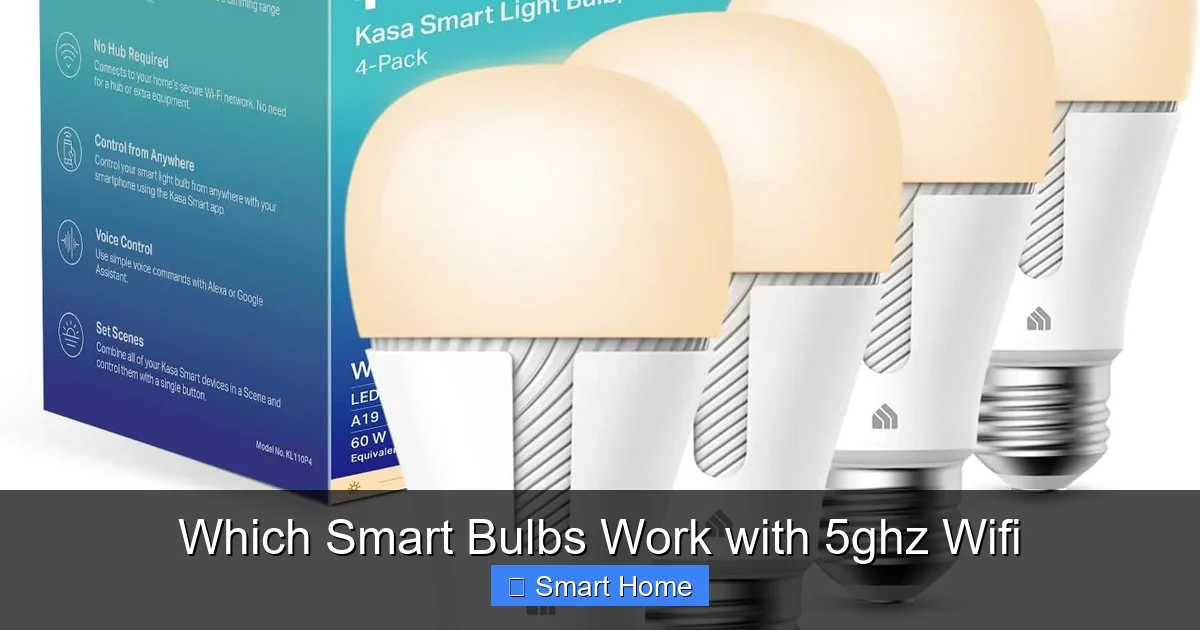
Most smart bulbs don’t support 5GHz Wi-Fi because they use 2.4GHz for broader compatibility. However, some advanced models from brands like Philips Hue, LIFX, and TP-Link do offer dual-band support. Choosing a 5GHz-compatible bulb can reduce interference and improve responsiveness in dense networks. This guide walks you through which bulbs work with 5GHz, why it matters, and how to pick the best one for your smart home.
Key Takeaways
- 5GHz Wi-Fi is faster but has shorter range: Ideal for smart homes with minimal interference, but struggles through walls.
- Most smart bulbs use 2.4GHz: Due to better wall penetration and universal router support, 2.4GHz remains the standard.
- Dual-band bulbs exist: A few premium models support both 2.4GHz and 5GHz, offering flexibility and reduced lag.
- 5GHz improves performance: Less congestion means faster response times and smoother control via apps or voice assistants.
- Check bulb specifications: Always verify Wi-Fi bands in the product manual or manufacturer’s website before purchasing.
- Router placement matters: Even with 5GHz support, signal strength depends on your router’s location and environment.
- Not all hubs support 5GHz: Some smart bulb hubs (like older Philips Hue bridges) only work with 2.4GHz networks.
📑 Table of Contents
- Which Smart Bulbs Work With 5GHz Wi-Fi?
- Understanding Wi-Fi Bands: 2.4GHz vs. 5GHz
- Which Smart Bulbs Support 5GHz Wi-Fi?
- Benefits of Using 5GHz Wi-Fi with Smart Bulbs
- Limitations and Challenges of 5GHz Smart Bulbs
- How to Set Up Smart Bulbs with 5GHz Wi-Fi
- Smart Bulb Recommendations for 5GHz Wi-Fi
- Common Myths About 5GHz Smart Bulbs
- Conclusion: Is 5GHz Worth It for Smart Bulbs?
Which Smart Bulbs Work With 5GHz Wi-Fi?
Imagine this: you’re in your living room, dimming the lights with your voice through Alexa, but the bulb flickers or doesn’t respond. Annoying, right? This is often due to Wi-Fi interference or network congestion—especially in homes packed with smart devices. Now, picture a world where your smart bulbs respond instantly, stay connected even through thick walls, and work flawlessly in crowded networks. That’s the promise of 5GHz Wi-Fi, and it’s becoming more relevant as smart home tech evolves.
But here’s the catch: most smart bulbs still rely on 2.4GHz Wi-Fi, and for good reason. The 2.4GHz band offers better range and can penetrate walls more effectively, making it ideal for home use. However, as Wi-Fi networks grow more crowded and devices multiply, the limitations of 2.4GHz become harder to ignore. This is where 5GHz comes in—faster speeds, less interference, and better performance for high-bandwidth tasks. But not all smart bulbs support it. So, which ones do? And should you switch?
In this article, we’ll break down everything you need to know about smart bulbs that work with 5GHz Wi-Fi, why it matters, and how to choose the best one for your home. Whether you’re building a smart lighting system or upgrading an existing one, this guide will help you make informed decisions and avoid common pitfalls.
Understanding Wi-Fi Bands: 2.4GHz vs. 5GHz
Before we dive into which smart bulbs support 5GHz, let’s quickly cover the basics of Wi-Fi bands. Wi-Fi routers operate on two primary frequency bands: 2.4GHz and 5GHz. Each has its strengths and weaknesses, and understanding them helps you choose the right tech for your home.
What Is 2.4GHz Wi-Fi?
The 2.4GHz band has been around since the early days of Wi-Fi. It’s slower than 5GHz—typically up to 600 Mbps—but it has a longer range and can pass through walls, ceilings, and floors more easily. This makes it ideal for devices that need to stay connected over longer distances, like smart bulbs in a basement or far corner of a house.
However, 2.4GHz is also crowded. Many devices—microwaves, cordless phones, baby monitors—use this band, leading to interference and slower speeds. In dense urban areas or apartments, this congestion can cause lag, disconnections, or unresponsive smart devices.
What Is 5GHz Wi-Fi?
Introduced in the 2010s, 5GHz Wi-Fi offers faster speeds—up to 1,300 Mbps or more—and significantly less interference. It’s perfect for bandwidth-heavy tasks like streaming 4K video or video calls. But it has a shorter range and struggles to penetrate solid objects like concrete walls or metal surfaces.
For smart bulbs, 5GHz can mean snappier responses and fewer dropouts, especially in homes with many connected devices. But it’s not a perfect solution. If your bulb is far from the router or in a basement, 5GHz may not reach it reliably.
Why Most Smart Bulbs Use 2.4GHz
Smart bulbs are designed for simplicity and reliability, not high-speed data transfer. They don’t stream video or download large files—just send small commands (“turn on,” “dim to 50%,” “set to blue”). So why not use 5GHz?
The main reason is compatibility. Most Wi-Fi routers still broadcast only 2.4GHz, and older devices rely on it. Also, 2.4GHz works better in real-world home environments with walls and obstacles. Finally, 5GHz requires more power, which smart bulbs—especially those powered by low-voltage LEDs—can’t always provide.
That said, some manufacturers are starting to offer dual-band support, allowing bulbs to connect to either frequency. This gives users more flexibility and future-proofs their setup.
Which Smart Bulbs Support 5GHz Wi-Fi?
Now, let’s get to the heart of the question: which smart bulbs actually work with 5GHz Wi-Fi? The short answer: not many—but some do. Most mainstream brands still default to 2.4GHz, but a few premium models offer dual-band support. Below are some of the best options currently available.
Philips Hue (Select Models)
Philips Hue is one of the most popular smart lighting systems, but its bulbs typically connect via a dedicated hub (the Hue Bridge), not directly to Wi-Fi. The bridge itself runs on 2.4GHz, so even though the bulbs are powerful and feature-rich, they don’t use 5GHz.
However, Philips has started introducing newer models like the Hue White and Color Ambiance A19 and Hue White and Color Ambiance BR30 with improved connectivity. While these still rely on the 2.4GHz hub, Philips has hinted at future 5GHz support in upcoming firmware updates. For now, though, 5GHz isn’t a feature you can count on.
LIFX Bulbs (Dual-Band Models)
LIFX stands out in the smart bulb market because many of its models support dual-band Wi-Fi—both 2.4GHz and 5GHz. This means you can connect directly to your router without a hub, reducing clutter and simplifying setup.
Popular LIFX models like the LIFX Mini Color, LIFX A19, and LIFX BR30 offer full 5GHz support. They’re known for fast response times, vibrant colors, and seamless integration with Alexa, Google Assistant, and Apple HomeKit. If you want a smart bulb that works with 5GHz Wi-Fi, LIFX is one of the best choices.
TP-Link Kasa Smart Bulbs
TP-Link’s Kasa brand offers affordable smart bulbs with growing features. The Kasa Smart Wi-Fi LED Bulb (KL110) and KL125 support both 2.4GHz and 5GHz networks. You can set them up directly through the Kasa app, no hub required.
These bulbs are great for beginners, offering dimming, scheduling, and voice control. They’re also energy-efficient and compatible with major smart assistants. While not as advanced as LIFX or Philips Hue, they’re reliable and budget-friendly—and they do work with 5GHz Wi-Fi.
Wyze Bulb (5GHz Support in Select Regions)
Wyze is known for affordable smart home devices, and its Wyze Bulb Color (ZB-RGBW02) supports dual-band Wi-Fi. In some regions, Wyze has enabled 5GHz connectivity, allowing direct router pairing without a hub.
However, 5GHz support isn’t universal—it depends on your router and location. Wyze recommends checking the app for compatibility. Still, if you’re using a modern router with 5GHz enabled, this bulb can be a solid, low-cost option.
Nanoleaf Essentials (Limited 5GHz Support)
Nanoleaf’s Essentials line (like the A19 bulb) uses a Matter protocol for connectivity, which can work over both 2.4GHz and 5GHz, depending on your router and setup. While Nanoleaf doesn’t always advertise 5GHz support explicitly, some users report success with direct router connections.
These bulbs are designed for Matter compatibility, meaning they’ll work across ecosystems. If you’re investing in a Matter-based smart home, Nanoleaf is worth considering—but verify 5GHz support with customer service before buying.
Other Brands to Watch
Brands like Sengled, Philips Hue (future models), and Kasa by TP-Link are gradually adding dual-band support. Keep an eye on product specs and firmware updates, as 5GHz compatibility may roll out over time.
Benefits of Using 5GHz Wi-Fi with Smart Bulbs
So, why go through the trouble of finding a smart bulb that works with 5GHz Wi-Fi? The benefits may seem minor at first, but they add up—especially in busy smart homes.
Faster Response Times
5GHz networks are less congested than 2.4GHz, meaning your smart bulb receives commands more quickly. No more delays when you say, “Alexa, turn off the lights.” The action happens instantly.
Reduced Interference
In homes with many smart devices (thermostats, cameras, speakers), 2.4GHz can become a bottleneck. 5GHz avoids this by operating on a cleaner frequency band, reducing dropouts and improving reliability.
Better Performance in Dense Networks
If you have a smart home with dozens of connected devices, 5GHz helps prioritize bandwidth. Your smart bulb gets the signal it needs, even when the network is busy.
No Hub Required (for Some Models)
Bulbs like LIFX and Kasa can connect directly to your router using 5GHz, eliminating the need for a separate hub. This saves money and reduces clutter.
Future-Proofing
As more devices move to 5GHz, using compatible bulbs ensures your smart home stays compatible with evolving Wi-Fi standards and smart ecosystems.
Limitations and Challenges of 5GHz Smart Bulbs
While 5GHz offers advantages, it’s not a perfect solution. There are trade-offs to consider before switching.
Shorter Range
5GHz signals don’t travel as far as 2.4GHz. If your router is in the living room and your bulb is in the bedroom or basement, the connection may drop or become unstable.
Wall Penetration Issues
Thick walls, metal structures, or concrete can block 5GHz signals. This makes it less reliable in multi-story homes or older buildings.
Router Compatibility
Not all routers support 5GHz, especially older models. You’ll need a modern dual-band or tri-band router to take advantage of 5GHz bulbs.
Power Consumption
5GHz connections can use more power, which may reduce the lifespan of battery-operated smart bulbs. While most smart bulbs are plug-in devices, this can affect overall efficiency.
Setup Complexity
Connecting a 5GHz bulb to your router requires a compatible network and sometimes a strong signal. If your router is far away, setup can be tricky.
Not All Ecosystems Support It
Some smart home platforms (like older versions of Apple HomeKit or Google Home) may not fully support 5GHz connections, limiting integration.
How to Set Up Smart Bulbs with 5GHz Wi-Fi
Ready to upgrade to a 5GHz smart bulb? Here’s how to set it up safely and effectively.
Step 1: Check Your Router
Ensure your router supports 5GHz Wi-Fi. Look for dual-band or tri-band labels. If you’re unsure, check your router’s manual or manufacturer’s website.
Step 2: Enable 5GHz on Your Router
Log into your router’s admin panel (usually via a web browser) and enable the 5GHz band. Make sure it’s broadcasting and secure (use WPA2 or WPA3 encryption).
Step 3: Choose a 5GHz-Compatible Bulb
Pick a bulb from a brand that supports dual-band Wi-Fi, like LIFX, Kasa, or Wyze. Confirm 5GHz support in the product description or manual.
Step 4: Reset the Bulb
Turn the bulb off and on five times rapidly to put it in pairing mode. This varies by brand—check the instructions.
Step 5: Connect via App
Open the bulb’s app (e.g., LIFX, Kasa, Wyze). Select your 5GHz network from the list of available Wi-Fi networks. Enter your password and wait for the connection.
Step 6: Test the Connection
Use voice commands or the app to control the bulb. If it responds quickly and consistently, you’re all set. If not, move the bulb closer to the router or consider a Wi-Fi extender.
Pro Tips:
- Place your router centrally for best 5GHz coverage.
- Use a Wi-Fi analyzer app to check signal strength in your home.
- Keep your router firmware updated for optimal performance.
- If 5GHz fails, fall back to 2.4GHz—most bulbs support both.
Smart Bulb Recommendations for 5GHz Wi-Fi
Not sure which bulb to buy? Here are our top picks for 5GHz-compatible smart bulbs, based on performance, ease of use, and value.
Best Overall: LIFX A19
The LIFX A19 is a top-tier smart bulb that supports dual-band Wi-Fi, including 5GHz. It offers vibrant colors, 1100 lumens of brightness, and instant voice control. No hub required—just plug in and connect.
Best Budget: TP-Link Kasa KL110
For under $20, the Kasa KL110 delivers reliable smart lighting with dual-band support. It’s easy to set up and works with Alexa and Google Assistant.
Best for Color: LIFX Mini Color
Compact and powerful, the LIFX Mini Color fits in small fixtures and supports 5GHz. It’s perfect for accent lighting with rich, saturated colors.
Best for Smart Home Hubs: Wyze Bulb Color
Affordable and versatile, the Wyze Bulb Color supports dual-band Wi-Fi and integrates with the Wyze app for scheduling and automation.
Best for Future-Proofing: Nanoleaf Essentials A19
With Matter protocol support, this bulb can work over 5GHz and is designed for long-term compatibility across smart ecosystems.
Common Myths About 5GHz Smart Bulbs
There are plenty of misconceptions about 5GHz and smart bulbs. Let’s clear them up.
Myth 1: All Smart Bulbs Support 5GHz
False. Most still use 2.4GHz for compatibility and range. Only select models from LIFX, Kasa, and Wyze offer dual-band support.
Myth 2: 5GHz Is Always Better
Not necessarily. If your router is far away or walls block the signal, 2.4GHz may be more reliable. It depends on your home layout.
Myth 3: You Need a New Router
Not always. Many modern routers support 5GHz, but if yours is older, you may need an upgrade. Check your router’s specs.
Myth 4: 5GHz Bulbs Use More Power
They may use slightly more power, but the difference is minimal. Most smart bulbs are low-power devices anyway.
Myth 5: 5GHz Is the Future
It could be, but 2.4GHz is still widely used and reliable. The transition is gradual.
Conclusion: Is 5GHz Worth It for Smart Bulbs?
So, should you switch to a smart bulb that works with 5GHz Wi-Fi? The answer depends on your needs. If you live in a crowded apartment with many smart devices, 5GHz can reduce lag and improve responsiveness. If you want a hub-free setup, dual-band bulbs like LIFX or Kasa are excellent choices.
However, if your home has thick walls, a far-flung router, or older smart devices, 2.4GHz may still be more reliable. The key is to evaluate your network and choose a bulb that fits your environment.
As smart home tech evolves, expect more bulbs to support 5GHz. For now, the best approach is to pick a dual-band model, ensure your router supports it, and test the connection. With the right setup, 5GHz smart bulbs can deliver faster, smoother control—making your home smarter and more responsive.
Frequently Asked Questions
Do all smart bulbs work with 5GHz Wi-Fi?
No, most smart bulbs use 2.4GHz Wi-Fi for better range and compatibility. Only select models from brands like LIFX, TP-Link Kasa, and Wyze support 5GHz.
Can I use 5GHz Wi-Fi with Philips Hue bulbs?
Philips Hue bulbs connect via a dedicated 2.4GHz hub (the Hue Bridge), so they don’t use 5GHz. Future models may support it, but not currently.
What happens if my 5GHz signal is weak?
If the 5GHz signal is weak, your smart bulb may disconnect or respond slowly. Move the bulb closer to the router or consider a Wi-Fi extender.
Are 5GHz smart bulbs more expensive?
Not always. Some dual-band bulbs like the TP-Link Kasa KL110 are affordable, while premium models like LIFX can cost more. Prices vary by features and brand.
Can I use both 2.4GHz and 5GHz with the same bulb?
Yes, many dual-band smart bulbs (like LIFX and Kasa) support both frequencies. You can choose which network to connect to during setup.
Will 5GHz Wi-Fi improve my smart bulb’s lifespan?
No direct link. Smart bulb lifespan depends on build quality and usage, not the Wi-Fi band. However, 5GHz can reduce strain from network congestion.