Adjustable Arm Desk Lamp
Adjustable Arm Desk Lamp is an essential topic that provides valuable insights.
Key Takeaways
- Precision Lighting: The multi-jointed arms let you position the light source with surgical accuracy, eliminating glare and shadows on your work surface.
- Eye Health Guardian: Proper, adjustable task lighting significantly reduces eye fatigue, headaches, and long-term strain from prolonged screen or paper work.
- Space-Saving Design: Unlike bulky traditional lamps, the articulated arm folds compactly against the desk when not in use, maximizing your valuable workspace.
- Technology Matters: Look for LED lamps with adjustable color temperature (warm to cool white) and dimming capabilities to match the time of day and task.
- Stability is Key: A heavy, well-weighted base or a sturdy clamp is essential to prevent tipping when you adjust the arms into extended positions.
- Beyond the Desk: These lamps excel for hobbies like model-building, sewing, jewelry-making, and as a reading light beside a chair or bed.
📑 Table of Contents
- The Unseen Hero of Your Workspace: Why Your Desk Lamp Matters
- How an Adjustable Arm Lamp Transforms Your Daily Workflow
- Anatomy of a Great Lamp: Understanding the Mechanism
- Essential Features to Look For: Beyond the Bendy Arm
- From Setup to Habit: Integrating Your Lamp into Your Routine
- Top Use Cases: It’s Not Just for Spreadsheets
- Making Your Choice: A Simple Buying Checklist
- Conclusion: Light the Way to Comfort and Clarity
The Unseen Hero of Your Workspace: Why Your Desk Lamp Matters
Think about your desk. You’ve invested in a great chair, a monitor at the perfect height, and an organized setup. But what about the light? The humble desk lamp is often an afterthought, a basic utility. Yet, poor lighting is a silent productivity killer. It causes squinting, shoulder tension from hunching, and that dreaded 3 PM headache. This is where the adjustable arm desk lamp stops being a mere accessory and becomes an essential piece of ergonomic equipment. It’s not just about seeing; it’s about seeing comfortably, clearly, and without pain. In this guide, we’ll shed light on everything you need to know to choose and use the perfect flexible lighting solution for your home office, study, or creative nook.
How an Adjustable Arm Lamp Transforms Your Daily Workflow
Eradicating Eye Strain at the Source
The human eye is not designed to stare at a single, flat plane for hours, especially under poor or inconsistent lighting. A fixed lamp either floods your entire room (wasting energy and creating ambient glare) or leaves dark patches on your desk. The adjustable arm desk lamp puts you in control. You can angle the light to illuminate just your keyboard and hands, leaving your monitor screen free from reflections. Need to switch from typing to signing a document? A quick twist of a joint or a gentle pull on the arm directs the beam instantly. This precision prevents your pupils from constantly dilating and constricting as you look between a bright lamp and a darker screen, which is a primary cause of digital eye strain.
Visual guide about Adjustable Arm Desk Lamp
Image source: 3dmodels.org
The Ergonomics of Light Direction
Ergonomics isn’t just about chair height and keyboard tilt; light direction is a critical part of the equation. Light should come from the side opposite your dominant hand to avoid casting your own shadow onto your work. For a right-handed person, the lamp should be on the left side of the desk. An adjustable arm makes achieving this ideal position effortless, regardless of your desk layout. You can sweep the arm over to the correct side, tilt the head down at the perfect 30-45 degree angle, and lock it in place. This creates a consistent, shadow-minimized field of light exactly where your tasks live.
Mood and Energy Regulation with Color Temperature
Modern LED adjustable arm desk lamps go beyond simple on/off switches. Many feature tunable white light, allowing you to shift the color temperature. Cool, blue-rich light (5000K-6500K) mimics midday sun, promoting alertness and focus—perfect for morning deep work. Warm, amber-toned light (2700K-3000K) resembles sunset, signaling your body to wind down and supporting natural melatonin production for the evening. By simply adjusting a button or dial, your lamp can help regulate your circadian rhythm, making your workspace a tool for both productivity and wellbeing.
Anatomy of a Great Lamp: Understanding the Mechanism
Not all “adjustable” arms are created equal. The mechanism determines the lamp’s feel, durability, and ease of use. Understanding these components is key to making a wise investment.
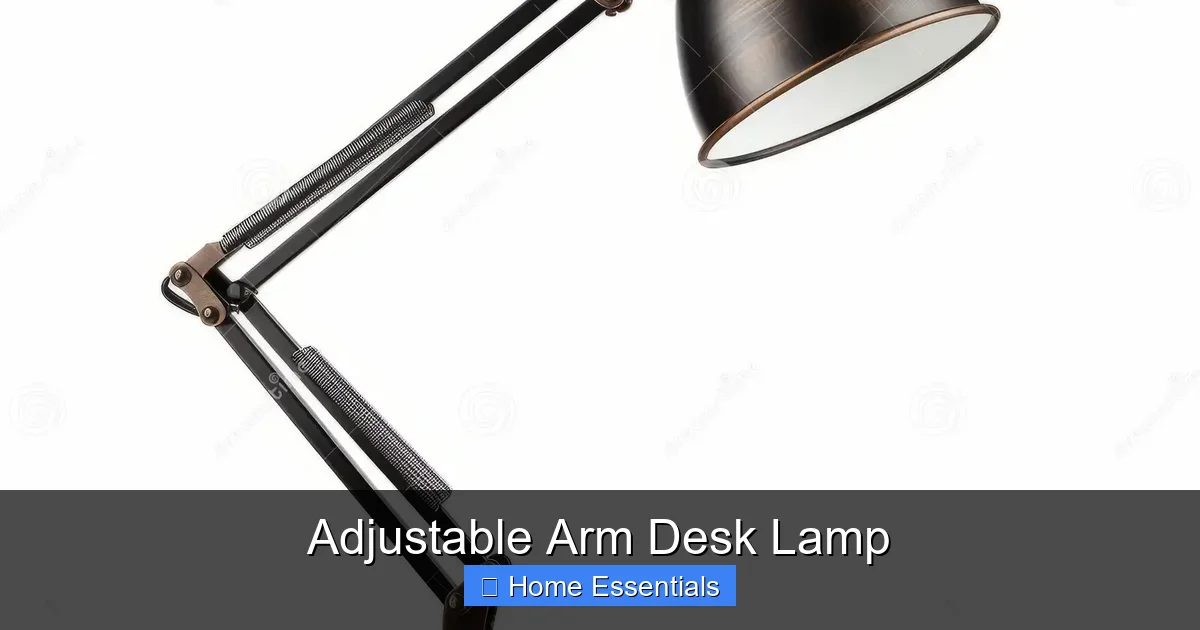
Visual guide about Adjustable Arm Desk Lamp
Image source: thumbs.dreamstime.com
Spring vs. Friction vs. Counterbalance Systems
- Spring-Loaded (The Classic): Common in many mid-range models. Internal springs provide tension, allowing you to move the arm and it holds roughly where you leave it. They offer a good balance of cost and function but can feel “sticky” over time and may require occasional adjustment.
- Friction (The Workhorse): Uses tightly fitted joints with no moving parts. You physically tighten a knob or twist a collar to lock the arm in place. This offers absolute stability—once locked, it won’t budge. It’s found in many professional architectural lamps. The downside is you must unlock and retighten for every adjustment, which can be tedious for frequent micro-adjustments.
- Counterbalance (The Luxury): The gold standard, often using internal gas springs or sophisticated mechanical linkages (like those in high-end drafting lamps). The lamp’s weight is perfectly balanced, so you can move it with one finger and it stays put. It provides the smoothest, most effortless adjustment. Think of it like the difference between a cheap office chair and an high-end ergonomic one.
The Base: Your Foundation of Stability
No matter how good the arm, a wobbly base ruins everything. There are two primary types:
- Weighted Base: A heavy, often metal disc that sits on your desk. Look for a low center of gravity (wider and heavier is better). This is great for permanent desk spots but takes up surface area.
- Clamp Base: A sturdy C-clamp that attaches to the edge of your desk. This is a space-saver and often provides a more rigid connection, as the force is transferred directly to the desk frame. Ensure your desk edge is thick and sturdy enough for the clamp’s capacity.
Essential Features to Look For: Beyond the Bendy Arm
The arm is the star, but the supporting features determine if your lamp is a star or a supporting player.

Visual guide about Adjustable Arm Desk Lamp
Image source: p1.liveauctioneers.com
Light Quality: Lumens, CRI, and Color Temperature
Don’t just buy based on wattage. For LEDs, focus on:
- Lumens: This is the actual brightness output. For a desk lamp, 300-500 lumens is usually sufficient for focused tasks. More isn’t always better; it’s about directed output.
- CRI (Color Rendering Index): A score of 80+ is good, 90+ is excellent. This measures how accurately the light reveals the true colors of objects. Crucial for artists, designers, or anyone working with color.
- Color Temperature (Kelvin): As mentioned, tunable white (2700K-6500K) is a major premium feature. If you can only choose one, a neutral white around 4000K-4500K is a versatile, comfortable all-rounder.
Smart Controls and Dimming
A simple on/off switch is a missed opportunity. Look for:
- Touch Controls: Clean, seamless bases. Often include long-press for dimming.
- Memory Function: Remembers your last brightness and color temperature setting, so you don’t have to reset every morning.
- Wireless Charging (Bonus): Some modern bases integrate a Qi charging pad for your phone, a fantastic space-saving combo.
- Timer & Sleep Mode: Automatically dims or turns off after a set period, saving energy and gently nudging you to take a break.
From Setup to Habit: Integrating Your Lamp into Your Routine
The 20-20-20 Rule, Illuminated
Eye experts recommend the 20-20-20 rule: every 20 minutes, look at something 20 feet away for 20 seconds. Use your adjustable arm desk lamp to reinforce this. When you lean back for your 20-second break, you can also adjust the lamp’s angle slightly to give your primary focal area a momentary “rest” from direct light, or switch it to a warmer, dimmer setting to signal a mental pause.
Positioning for Dual-Monitor Setups
Dual monitors complicate lighting. The goal is to light the *area* without highlighting the *screens*. Place the lamp to the side, not directly in front of you. Use the adjustable arm to extend the lamp head over the desk edge, positioning it to cast light across the desk surface between the two monitors, not onto them. A wider beam spread (often called “flood” vs. “spot”) is beneficial here.
Maintenance and Longevity Tips
LEDs last a long time, but they aren’t indestructible. Keep the lamp head clean from dust, which can insulate heat and degrade the LED faster. Use a soft, dry microfiber cloth. Don’t overtighten friction joints—they should hold firmly with a snug turn, not brute force. Periodically check the base or clamp connection to ensure it remains secure. A well-cared-for adjustable arm lamp can easily last 10+ years.
Top Use Cases: It’s Not Just for Spreadsheets
While perfect for the office, the versatility of a flexible arm lamp makes it a multi-room hero.
- The Artist’s Assistant: Position the arm and head to eliminate shadows on a canvas or sketchpad. Use high CRI light for accurate color mixing.
- The Maker’s Third Hand: For intricate hobbies like model building, circuit soldering, or sewing, the arm can be bent to hold the light at a perfect angle over tiny components, leaving both hands free.
- The Bedside Reader: A clamp-on model can attach to a headboard or nightstand shelf, directing light onto your book without illuminating the whole room and disturbing a partner.
- The Kitchen Counter Companion: A sturdy clamp lamp can provide focused task lighting over a cutting board or recipe book in a dimly lit kitchen corner.
- The Video Call Pro: Position the lamp to the side and slightly above your face to provide even, flattering key light that eliminates under-eye shadows during Zoom calls.
Making Your Choice: A Simple Buying Checklist
Before you click buy, run through this quick list:
- Measure Your Desk: Know the depth and the thickness of the edge if considering a clamp. Ensure the lamp’s maximum reach (arm length + head extension) covers your primary work area.
- Choose Your Mechanism: For frequent, micro-adjustments, prioritize counterbalance or smooth friction. For set-and-forget, a simple spring or lockable friction is fine.
- Prioritize Light Quality: Aim for tunable white, a CRI of 90+, and smooth, flicker-free dimming (check reviews for “PWM” issues).
- Base Type Decision: Weighted for a dedicated spot, clamp for space-saving and rigidity. Ensure the clamp’s maximum grip thickness matches your desk.
- Read the Fine Print: Check the warranty (2+ years is good), the LED lifespan (50,000 hours is standard), and if the USB port is for charging only or data transfer.
- Style & Material: Metal (aluminum, steel) is more durable and premium than plastic. Consider the finish—matte black, brushed nickel, or white—to match your decor.
Conclusion: Light the Way to Comfort and Clarity
The adjustable arm desk lamp is more than a purchase; it’s an upgrade to your daily wellbeing. It’s the difference between tolerating your workspace and truly thriving in it. By understanding the mechanics, focusing on quality light, and integrating it mindfully into your routine, you invest in sharper focus, healthier eyes, and a more enjoyable time spent at your desk. Whether you’re a remote worker, a student, a creative hobbyist, or an avid reader, the right lamp doesn’t just illuminate your page—it illuminates your potential. Take the time to choose wisely, and let your work shine in the best possible light.
Frequently Asked Questions
Can I use an adjustable arm desk lamp with a standing desk?
Absolutely. In fact, they are ideal. The adjustability allows you to reposition the light perfectly as you raise or lower the desk, maintaining optimal light angle without having to move the lamp base. A clamp-on model is especially stable on a moving desk surface.
Are LED adjustable lamps worth the higher cost compared to incandescent or halogen?
Without a doubt. LEDs use a fraction of the energy, produce minimal heat, and last for tens of thousands of hours. The higher upfront cost is offset by decades of not buying bulbs and lower electricity bills. They also enable the crucial features of dimming and tunable color temperature that incandescent bulbs can’t match efficiently.
How do I prevent my lamp from tipping over when the arm is fully extended?
This is a stability issue. First, ensure you have a sufficiently heavy base or a properly clamped model. Second, avoid extending the arm to its absolute maximum if it feels precarious. Many lamps have a “sweet spot” where the arm is long but the center of gravity remains over the base. A wider, heavier base provides a much larger safety margin.
What’s the difference between a “drafting lamp” and a regular adjustable desk lamp?
The terms are often used interchangeably. True drafting lamps are a subtype designed for architects and engineers. They typically feature a very long, counterbalanced arm (often 24+ inches), a large, weighted base, and a shade that provides very even, shadow-minimizing illumination over large blueprints or drawings. They are built for maximum reach and precision.
Should I choose a lamp with a USB port?
It’s a convenient modern feature, but not essential. If you often need to charge a phone or earbuds at your desk and have limited outlet space, a built-in USB-A or USB-C port (check the amperage for charging speed) is a great space-saver. Just ensure it doesn’t compromise the lamp’s stability or primary lighting function.
Is a touch-sensitive control better than a physical switch?
It’s a matter of preference. Touch controls offer a sleek, seamless look and often integrate dimming. Physical switches can be more tactile and reliable (no need to swipe through settings if you just want on/off). Consider your environment—touch controls can be accidentally activated by a passing sleeve, while physical buttons might collect dust in their crevices.