Can I Use a Desk Lamp for My Plants
Yes, you can often use a desk lamp for your plants, but not just any lamp will do. Success depends entirely on the type of bulb (LED, fluorescent), its light spectrum (blue/red wavelengths), and intensity. A standard incandescent desk lamp is usually ineffective and generates too much heat. You must select a full-spectrum or specifically designed grow bulb, position it correctly, and provide the right photoperiod. With the right setup, a desk lamp becomes a perfect, targeted solution for a single plant or a small cluster, supplementing ambient light in darker corners.
You’ve got a favorite ZZ plant or a sad-lookingMonstera on your desk, and the corner of your room is just too dark. Your trusty old desk lamp with its warm, cozy glow seems like the perfect solution. But before you flip that switch, let’s talk about what plants really need from light. The short answer is: sometimes, but with major caveats. Your typical desk lamp is designed for human vision, not plant photosynthesis. Let’s break down exactly when, how, and why you might—or might not—use a desk lamp for your green friends.
Key Takeaways
- Not All Desk Lamps Are Equal: The lamp’s bulb is everything. Standard incandescent bulbs are poor choices; you need a full-spectrum LED or fluorescent grow bulb for effective photosynthesis.
- Light Spectrum is Critical: Plants primarily use blue light for vegetative growth and red light for flowering. A “full-spectrum” bulb mimics natural sunlight, providing a balanced mix.
- Distance and Intensity Matter: Place the lamp 6-24 inches from foliage, depending on bulb wattage. Too close causes burn; too far means insufficient light.
- Timing is Part of the Equation: Most plants need 12-16 hours of light daily. Use a simple outlet timer to automate the photoperiod and mimic natural day/night cycles.
- It’s for Supplemental or Small-Scale Use: A desk lamp is ideal for one plant, seedlings, or herbs on a desk. It is not a solution for lighting a large shelf or multiple mature plants.
- Heat is a Hidden Danger: Even some LEDs can produce heat. Always check the lamp’s temperature after an hour of use to prevent leaf scorch.
- Smart Bulbs Can Be a Flexible Option: Some smart bulbs offer grow light spectra and scheduling via an app, offering convenience. However, ensure they are designed for plant growth, not just human illumination.
📑 Table of Contents
- How Plants See Light: It’s Not About Brightness to Us
- Types of Desk Lamps & Bulbs: The Good, The Bad, The Useless
- Why Your Regular Desk Lamp Setup Will Likely Fail (And How to Fix It)
- Step-by-Step: Setting Up Your Desk Lamp for Plant Success
- Advanced Considerations: Smart Bulbs, Heat, and Plant Personalities
- Common Mistakes & When to Give Up on the Desk Lamp
How Plants See Light: It’s Not About Brightness to Us
We judge light by how bright it looks to our eyes. Plants use a completely different metric. They absorb specific wavelengths of light to power photosynthesis, primarily in the blue (400-500 nm) and red (600-700 nm) parts of the spectrum. A standard warm white or soft white incandescent bulb emits most of its energy in the green/yellow spectrum, which plants mostly reflect (which is why plants look green to us!). This makes it incredibly inefficient for plant growth.
The Photosynthetic Active Radiation (PAR) Concept
Gardeners and scientists talk about Photosynthetic Active Radiation (PAR). This is the range of light (400-700 nm) that plants can use. A good grow light, including a desk lamp bulb, will have a high output in the PAR range. You don’t need a PAR meter for home use, but understanding that a bulb’s “lumens” (human brightness) don’t equal “PAR” (plant food) is the first key insight.
Types of Desk Lamps & Bulbs: The Good, The Bad, The Useless
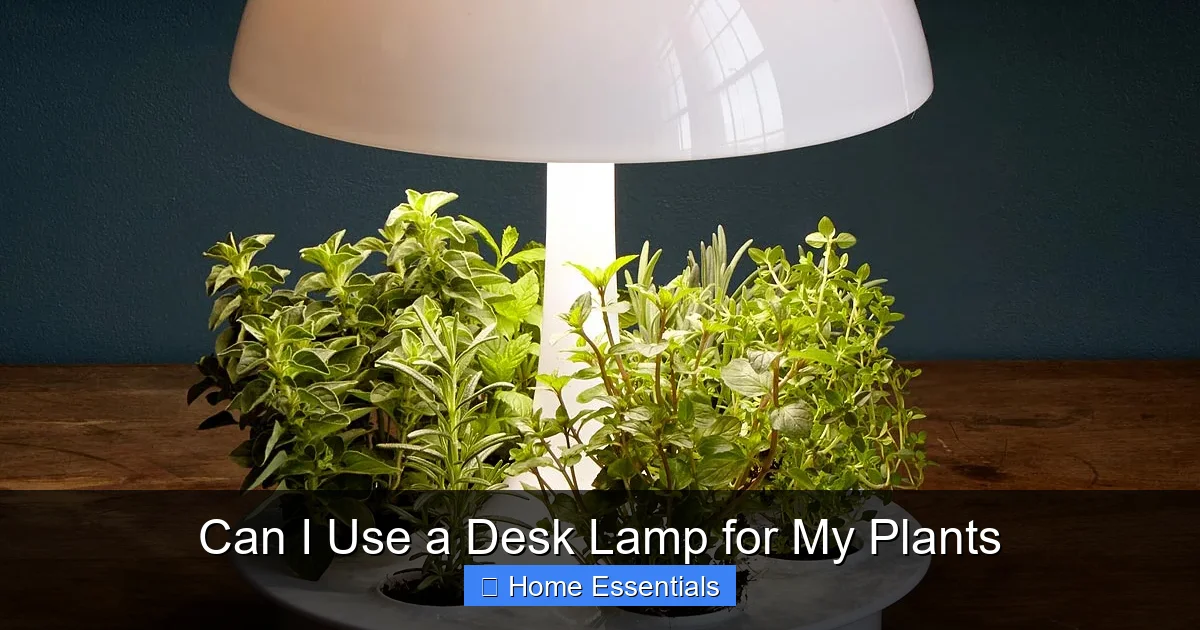
Your lamp’s hardware—the gooseneck, the clamp, the shade—is usually fine. The entire game is won or lost by the bulb screwed into the socket.
Visual guide about Can I Use a Desk Lamp for My Plants
Image source: uncommongoods.com
The Usual Suspect: Incandescent Bulbs (Avoid These)
That old 40-watt white bulb? It’s a no-go. Incandescents are thermal reactors that happen to emit light. They’re only about 5% efficient, wasting 95% of their energy as heat. This creates two problems: 1) They provide very little usable PAR light. 2) The intense heat can scorch leaves if placed too close, forcing you to position the lamp farther away, which further diminishes the already weak light. They are, essentially, tiny, expensive, and dangerous space heaters for your plants.
The Okay Option: Standard Fluorescent Bulbs (T5/T8)
Old-school shop lights use these. A standard “cool white” fluorescent tube is better than an incandescent because it emits more blue light. It’s a cost-effective way to start seedlings or low-light plants. However, its spectrum is narrow and peaks in the green spectrum. It’s a workable, not optimal, choice. You can find “full-spectrum” fluorescent tubes that are much better.
The Champion: LED Bulbs (The Modern Answer)
This is your best bet for a desk lamp. LEDs are cool-running, energy-efficient, and can be engineered to emit specific spectra. Look for bulbs labeled:
- Full-Spectrum / Sunlight Spectrum: These aim to mimic the sun’s broad spectrum. They are excellent all-arounders for foliage plants.
- Grow Light / Plant Light LEDs: These often have a more intense spike in the blue and red wavelengths. They are more focused and powerful for flowering or fruiting plants.
Pro Tip: Check the bulb’s wattage and lumen output. For a single desk plant, a 10-15W full-spectrum LED bulb (equivalent to a 60-75W incandescent) is a great starting point. You can also find small, clip-on LED grow light panels that fit over a lamp shade or attach directly to a pot.
Why Your Regular Desk Lamp Setup Will Likely Fail (And How to Fix It)
Let’s assume you’ve swapped the incandescent for an LED. Here’s where most people still go wrong.
Visual guide about Can I Use a Desk Lamp for My Plants
Image source: quidlo.com
Problem 1: It’s Too Dim
Light intensity, or PPFD (Photosynthetic Photon Flux Density), drops dramatically with distance (inverse square law). If your bulb is 12 inches from the plant, it provides 1/4 the light it would at 6 inches. A low-wattage bulb placed two feet away might as well be off. Solution: Get a brighter bulb (higher lumen/PAR output) and place it closer. For most tabletop plants, aim for the lamp to be 6-12 inches from the top leaves.
Problem 2: The Spectrum is Wrong
Using a “daylight” (5000K-6500K) LED bulb is usually fine for greens. But if you’re trying to get a Christmas cactus to bloom or a tomato plant to fruit, you need more red light. Solution: Purchase a dedicated “grow light” spectrum bulb for flowering plants, or a full-spectrum bulb that covers both phases adequately.
Problem 3: The Duration is Off
Plants need a consistent photoperiod. Leaving the lamp on 24/7 is worse than not having it; it disrupts their respiratory cycle. Solution: Use a cheap plug-in outlet timer. Set it for 14-16 hours for vegetative growth (herbs, foliage) or 12-14 hours for flowering plants. Consistency is key.
Problem 4: The Light is Too Static
In nature, the sun moves. A stationary lamp can cause uneven growth, with the plant leaning toward the source. Solution: Every week or two, rotate the plant 90 degrees. If your lamp has a flexible neck, slightly adjust its angle to illuminate different sides of the plant over time.
Step-by-Step: Setting Up Your Desk Lamp for Plant Success
Ready to try? Here’s a foolproof checklist.
Visual guide about Can I Use a Desk Lamp for My Plants
Image source: topshade.store
- Choose the Right Lamp: A lamp with an adjustable, flexible neck (like a classic architect lamp) is ideal. It must be stable and able to position the bulb directly over the plant without casting shadows from its own shade.
- Install the Correct Bulb: Screw in your new full-spectrum or grow LED bulb. Ensure it’s the appropriate base (E26/E27 is standard). If your lamp has a built-in LED module, you may need to replace the entire lamp head with a grow light panel.
- Position with Purpose: Place the lamp so the bulb is 6-12 inches above the plant’s highest point. For seedlings or cuttings, it can be as close as 3-4 inches (but monitor for dryness). Angle it to cover the entire plant canopy.
- Automate the Schedule: Plug the lamp into a digital outlet timer. Set it to turn on at your desired “sunrise” (e.g., 6 AM) and off at “sunset” (e.g., 10 PM).
- Monitor and Adjust: After a week, check your plant. Is it perking up? Are new leaves a healthy green? Are the tips of leaves turning brown or yellow? If bleaching or burning occurs, move the lamp higher or switch to a lower wattage. If growth is spindly and slow, move it closer or get a stronger bulb.
Advanced Considerations: Smart Bulbs, Heat, and Plant Personalities
Once you have the basics down, you can fine-tune for better results.
Can I Use a Smart Bulb as a Grow Light?
Some smart bulbs, like certain Philips Hue or Wyze models, offer a “grow light” or “plant light” scene in their app. These are typically full-spectrum LEDs. They can be excellent because you can program schedules, dim them, and even set color temperatures from your phone. However, their maximum brightness (lumens) is often capped for human comfort, so they may not be intense enough for flowering plants. Always check the specs for PAR output if available. For more on smart bulb capabilities, you can read about whether smart bulbs can be used as grow lights.
Heat Management: The Silent Killer
Even LEDs generate some heat at the base. Ensure your lamp’s design allows for airflow. Never drape a cloth over the lamp head. After 30 minutes of operation, carefully touch the bulb housing—it should be warm, not hot. If it’s too hot to touch, increase the distance or improve ventilation.
Know Your Plant’s “Light Hunger”
A low-light tolerant snake plant will thrive with less intense, farther lighting than a sun-worshipping fiddle leaf fig or a pepper plant. Research your specific plant’s needs. A general rule: leaf size and color are indicators. Large, dark green leaves usually mean lower light needs. Small, variegated, or colorful leaves often require higher light.
Common Mistakes & When to Give Up on the Desk Lamp
Pitfalls are easy to avoid with a little knowledge.
- Mistake: Using a lamp with a fabric or paper shade. These block most of the useful light. Fix: Remove the shade entirely or use a bare bulb.
- Mistake: Assuming one lamp can light a whole shelf of plants. Fix: One lamp = one or two small plants. For a shelf, you need a dedicated strip light or multiple lamps.
- Mistake: Forgetting that plants need darkness too. Fix: The timer is non-negotiable.
- Mistake: Not adjusting as the plant grows. Fix: Raise the lamp as your plant gets taller to maintain the optimal distance.
When to Abandon Ship: If you’ve optimized everything (correct bulb, proper distance, timer) and your flowering plant still won’t bloom or your succulent etiolates (stretches), your plant’s light demand exceeds what a single desk lamp can provide. It’s time to invest in a dedicated, higher-output grow light panel that can be dimmed and positioned for broader coverage.
Frequently Asked Questions
Can I use a regular LED desk lamp bulb for my plants?
It depends. A standard “daylight” or “cool white” LED bulb will provide some usable light and is better than an incandescent, but it may lack the balanced spectrum for optimal growth. For best results, use a bulb specifically marketed as “full-spectrum” or “grow light” LED.
How close should the desk lamp be to my plant?
For most full-spectrum LED grow bulbs, start with the bulb 6-12 inches above the plant’s foliage. Low-light plants can be farther (12-24 inches), while high-light plants or seedlings may need to be as close as 3-6 inches. Always monitor for signs of stress.
How many hours a day should I run my desk lamp for plants?
Most common houseplants and vegetables need 12-16 hours of light per day. Use a plug-in timer to automate this. Do not run it 24/7, as plants need a dark period for respiration and growth regulation.
Will a desk lamp provide enough light for flowering or fruiting?
Possibly, if you use a high-intensity, red-spectrum-focused grow bulb and keep it very close (6-8 inches) to a small, young flowering plant. For larger or multiple fruiting plants, a desk lamp’s output is usually insufficient. You’d need a more powerful dedicated grow light.
What are the signs my plant isn’t getting enough light from the desk lamp?
Look for etiolation: stems become long, thin, and weak as the plant stretches toward the light. Leaves may be smaller, pale, and spaced farther apart on the stem. Growth will be very slow or nonexistent.
Can I use a desk lamp with a smart bulb for plants?
Yes, if the smart bulb is designed to emit a full or grow spectrum. The advantage is easy scheduling and dimming via an app. However, ensure the bulb’s maximum brightness (lumens) is high enough for your plant type, as some smart bulbs prioritize ambiance over intensity.