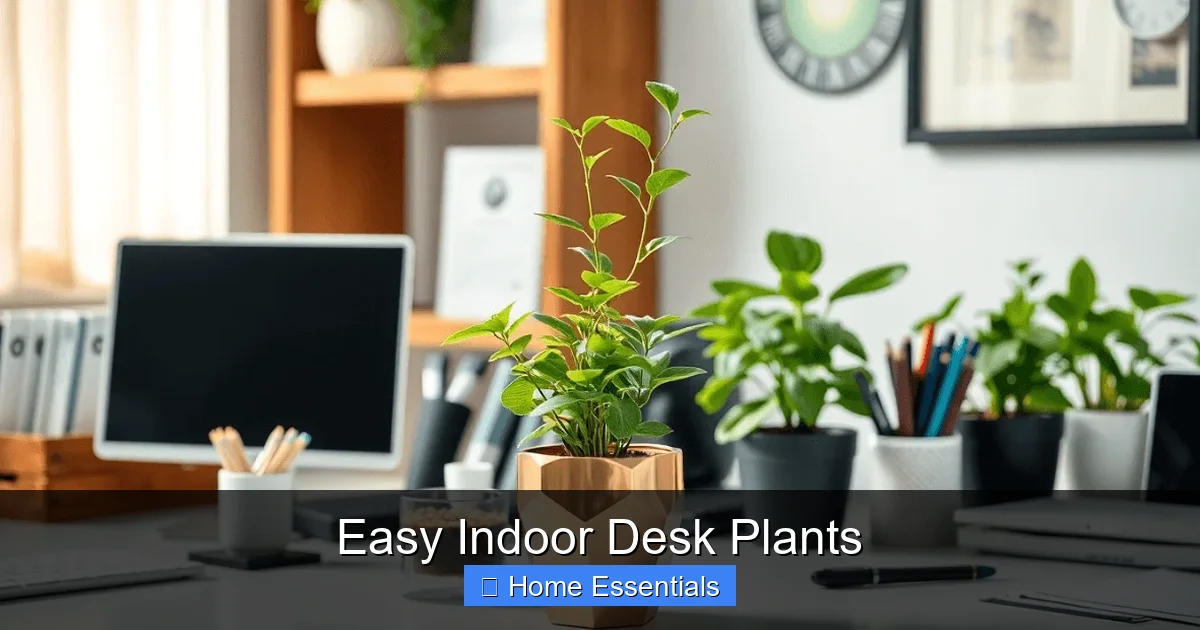
Easy Indoor Desk Plants
Bringing life to your desk doesn’t have to be complicated. This guide cuts through the noise to spotlight truly resilient indoor plants that thrive on neglect. We’ll walk you through specific, foolproof varieties, simple care routines that fit a busy schedule, and creative ways to style your green desk companion. Transform your workspace into a more vibrant, healthy, and productive environment with minimal effort.
Let’s be honest. The idea of a lush, green desk is incredibly appealing. It promises a touch of nature, a breath of fresh air in a boxed-in cubicle, and a little living thing that depends on you. But then the memories surface: the sad, crispy-leaved succulent from three jobs ago, the mysterious fern that just… gave up. The fear of becoming a plant parent, especially with a busy workday, feels real. What if I forget to water it? What if it needs complex fertilizer or a specific humidity level I can’t provide?
Here’s the great news: your desk is not a death sentence for greenery. In fact, some of the most resilient, adaptable, and rewarding plants on the planet are perfect for exactly this environment. They don’t want constant attention; they thrive on a little neglect. They’re not picky about light; they’re happy with what they can get. This isn’t about becoming a botanist; it’s about finding a quiet, green partner for your workspace that makes your day a little brighter without adding to your to-do list. We’re talking about true easy indoor desk plants.
This guide is your no-stress handbook. We’ll move beyond vague advice and dive into specific, tested varieties that have earned their “easy” badge. You’ll learn the two or three simple rules that cover 90% of their needs, how to read what your plant is telling you, and how to style them so they look intentional and chic, not like an afterthought. Let’s turn your desk from a sterile workstation into a personal, productive oasis.
Key Takeaways
- Low-light tolerance is key: The best desk plants survive in the dim, artificial light of an office or a room with few windows, making them virtually fail-proof.
- Watering is the #1 killer: Overwatering causes more plant deaths than underwatering. The “touch-test” soil method is more reliable than a strict watering schedule.
- Drainage is non-negotiable: Always use pots with drainage holes to prevent root rot. Decorative cachepots are fine as long as the nursery pot with holes sits inside.
- Air purification is a real benefit: Plants like the Snake Plant and Peace Lily are NASA-studied for filtering common volatile organic compounds (VOCs) from indoor air.
- Start with one, master it: Don’t overwhelm yourself. Choose one plant from this list, learn its rhythms, and add another once you feel confident.
- Your environment matters: Consider your desk’s specific conditions—humidity from a nearby vent, afternoon sun from a window, or a drafty spot—when selecting a plant.
- They boost well-being: Beyond aesthetics, studies show even a small desk plant can reduce stress, improve focus, and increase job satisfaction.
📑 Table of Contents
- What Makes a Plant “Easy” for Your Desk? The Core Criteria
- The All-Star Roster: 6 Foolproof Desk Plants
- The Simple Science of Care: Water, Light, and Soil Demystified
- Styling Your Green Desk: From Cluttered to Curated
- Troubleshooting 101: What Your Plant is Saying
- Conclusion: Your Green Journey Starts Now
What Makes a Plant “Easy” for Your Desk? The Core Criteria
Before we list the plants, we need a filter. Not every “low-maintenance” plant you read about is suited for the unique microclimate of a desk. A desk has specific challenges: inconsistent light from artificial bulbs or a distant window, potential drafts from air conditioning, the risk of being forgotten over a long weekend, and very limited space. The champions of the desk world excel in these areas.
The Holy Trinity of Desk Plant Success
If you remember nothing else, remember these three non-negotiables. Get these right, and you’ve won 80% of the battle.
- Tolerance for Low, Indirect Light: This is the top criterion. Your desk plant will not get strong, direct sunlight. It needs to photosynthesize happily in the glow of your computer screen, a standard LED desk lamp, or the ambient light of a north-facing room. Plants that demand “bright, direct light” are instant fails.
- Forgiving Watering Schedule: The ideal desk plant is drought-tolerant. It stores water in its leaves, roots, or stems, meaning if you forget to water it for an extra week (or two), it will simply slow down and perk up when you finally do. Plants that need consistently moist soil are a recipe for root rot in a workspace where you might not be paying daily attention.
- No Special Humidity or Temperature Needs: Offices and home workspaces are typically around 40-60% humidity and a stable room temperature (65-75°F / 18-24°C). Your plant must be happy here. Tropical plants that require 80% humidity and daily misting belong in a bathroom, not on your keyboard.
With that filter applied, a clear winner’s circle emerges. These plants have evolved to survive in the understory of forests or in arid, rocky environments—conditions that mimic our desk life perfectly.
The All-Star Roster: 6 Foolproof Desk Plants
Now for the fun part. These are the plants that have been tested in thousands of offices and home desks. They are the gold standard for a reason. Each profile includes its “easy” superpower, a crucial care tip, and a styling note.
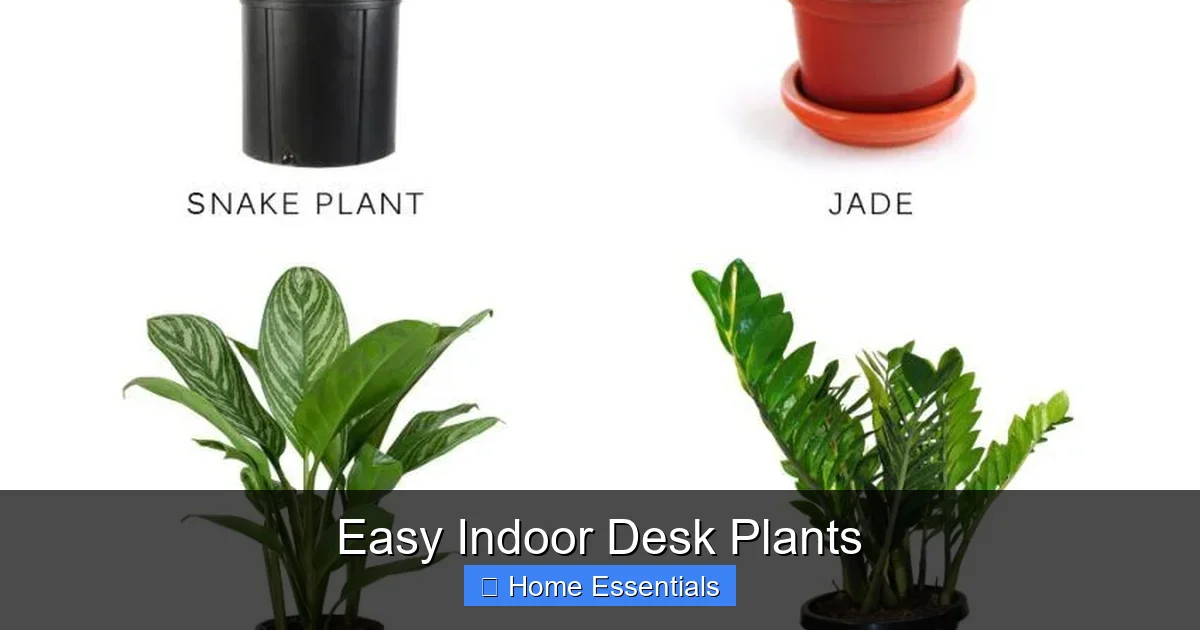
Visual guide about Easy Indoor Desk Plants
Image source: i.pinimg.com
1. The Indestructible Hero: Snake Plant (Sansevieria / Dracaena trifasciata)
Why it’s perfect: This is the undisputed champion. Often called “Mother-in-Law’s Tongue,” the Snake Plant is so resilient it’s almost impossible to kill on purpose, let alone by accident. It’s a succulent, storing water in its thick, upright leaves. It thrives on neglect, tolerates the lowest light conditions imaginable (a dark corner is fine), and can go over a month without water. It’s also a top air purifier, removing toxins like formaldehyde and benzene.
- Care Tip: Water only when the soil is completely dry. In a typical desk setting with no natural light, this might be every 3-6 weeks. Err on the side of underwatering. Use a well-draining potting mix (cactus/succulent mix is ideal).
- Styling: Its architectural, sword-like leaves add a modern, sculptural element. Choose a tall, narrow variety like ‘Sansevieria trifasciata’ for a floor plant beside a desk, or a compact ‘Hahnii’ (Bird’s Nest Snake Plant) that stays under 6 inches tall for right on the desktop.
2. The Graceful Survivor: ZZ Plant (Zamioculcas zamiifolia)
Why it’s perfect: The ZZ Plant is the silent guardian of the plant world. It has potato-like rhizomes underground that store massive amounts of water and nutrients. Its glossy, dark green leaflets grow in a perfectly symmetrical, elegant arch. Like the Snake Plant, it tolerates very low light and extremely infrequent watering. It grows slowly, so you won’t have to repot it often.
- Care Tip: The #1 mistake is overwatering. If the leaves start to turn yellow and feel mushy, you’ve watered too much. Let it dry out thoroughly between waterings. It prefers to be underwatered. A good rule is to water no more than once a month in low-light desk conditions.
- Styling: Its glossy foliage catches light beautifully. A small 4-inch pot looks great grouped with other plants or solo. Its tidy, rounded growth habit is perfect for a minimalist desk.
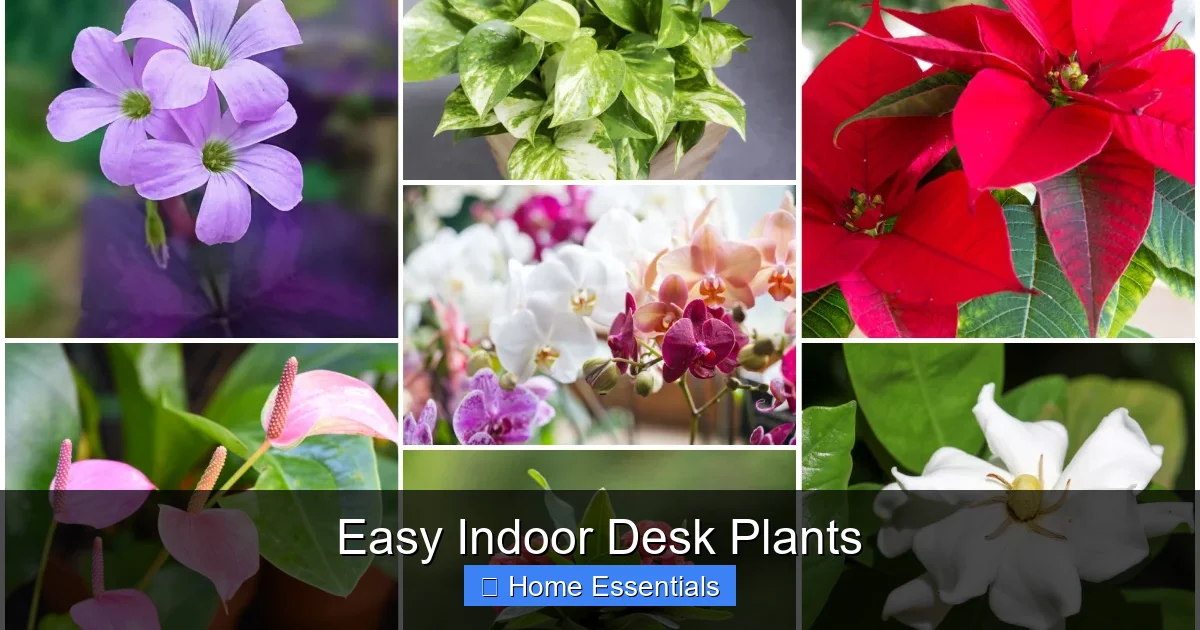
3. The Air-Purifying Powerhouse: Peace Lily (Spathiphyllum)
Why it’s perfect: If you want a plant that actually *talks* to you, the Peace Lily is it. It’s famous for its dramatic “dramatic droop” when it’s thirsty. The leaves literally wilt to tell you it needs water, making it foolproof for beginners. It’s also one of the best flowering plants for low light and a champion at filtering indoor air pollutants. It will occasionally produce a white, hooded flower (a spathe) even on a desk.
- Care Tip: Water when the leaves droop. Yes, wait for the sign! Then water thoroughly until it runs out the drainage holes. It will perk up within a few hours. It prefers consistently moist (but never soggy) soil compared to the two above, so you’ll water it more frequently—perhaps every 1-2 weeks. It’s sensitive to chlorine and fluoride in tap water; let water sit out overnight before using.
- Styling: The dark green leaves and white flowers provide a beautiful contrast. A small variety like ‘Spathiphyllum wallisii’ is perfect for a desk. Place it where you can see the droop as a helpful reminder.
4. The Trailblazer: Pothos (Epipremnum aureum)
Why it’s perfect: The classic, ubiquitous Pothos is a classic for a reason. It’s a vigorous vine that grows eagerly in almost any condition. It tolerates low light, irregular watering, and even a bit of neglect. Its heart-shaped leaves come in classic green or variegated forms (like Golden Pothos or Marble Queen). It’s incredibly easy to propagate—just snip a stem and put it in water.
- Care Tip: Water when the top inch of soil is dry. It’s more tolerant of dry soil than soggy soil. If leaves start to yellow, you’re likely overwatering. In very low light, variegated varieties may lose their variegation and revert to solid green—this is normal.
- Styling: Let it trail off the edge of your desk, down a bookshelf, or train it up a small moss pole for a vertical element. A small hanging basket suspended near your desk also works beautifully.
5. The Textural Wonder: Cast Iron Plant (Aspidistra elatior)
Why it’s perfect: Living up to its name, the Cast Iron Plant is tough as nails. It was a popular Victorian-era houseplant precisely because it survived the soot and low light of gas-lit homes. It has broad, dark green, leathery leaves that shoot straight up from the soil. It grows very slowly, requires minimal watering, and is completely unfazed by temperature fluctuations or low humidity.
- Care Tip: Water only when the soil is almost completely dry. It’s better to underwater this one. It has a shallow root system, so don’t overpot it. A pot just slightly larger than its root ball is perfect. Wipe the leaves occasionally with a damp cloth to remove dust and keep them glossy.
- Styling: Its bold, architectural foliage makes a statement. It’s ideal for a corner of a large desk or on a sturdy plant stand beside your workstation. It provides a solid, grounding element to your green collection.
6. The Pet-Friendly Option: Spider Plant (Chlorophytum comosum)
Why it’s perfect: For those with curious cats or dogs, the Spider Plant is a safe, non-toxic choice. It’s also incredibly adaptable and fast-growing. Its long, grassy leaves arch gracefully, and it produces “babies” or plantlets on thin stems that dangle down—a fun, unique feature. It’s excellent at removing formaldehyde from the air.
- Care Tip: Prefers to dry out between waterings. Brown leaf tips are often caused by fluoride in tap water or low humidity. Use filtered water and don’t let it sit in waterlogged soil. It appreciates a little more light than the others to maintain its variegation, but bright, indirect light is plenty.
- Styling: Its cascading habit is perfect for a hanging planter suspended from a ceiling hook near your desk, or a tall pot on a shelf where its babies can hang down. It creates a lovely, soft, fountain-like effect.
The Simple Science of Care: Water, Light, and Soil Demystified
You have your plant. Now what? The care rules for these easy indoor desk plants are refreshingly simple because they all follow the same anti-fragile philosophy. Forget complicated schedules. Learn these three principles instead.
Visual guide about Easy Indoor Desk Plants
Image source: houseplantcentral.com
The “Touch-Test” is Your Best Friend
Forget “water every Tuesday.” Your finger is your most reliable tool. For most of these plants (Snake Plant, ZZ, Cast Iron), you want the soil to be completely dry before watering. Stick your finger into the soil up to your first knuckle. If it feels dry, it’s time. If it feels cool or damp at all, wait. For the Peace Lily and Pothos, water when the top inch is dry. When you do water, do it thoroughly: water until it runs freely out the drainage holes, then let the pot drain completely. Never let the pot sit in a saucer full of water.
Light: It’s About Intensity, Not Just Presence
“Low light” for a plant does not mean “no light.” It means no direct sunbeams. A spot a few feet from a north or east-facing window, or under the bright, indirect glow of a full-spectrum LED desk lamp for 6-8 hours a day, is ideal. Rotate your plant a quarter turn every few weeks so it grows evenly and doesn’t lean toward the light source. If a plant’s new growth becomes long, thin, and pale (leggy), it’s screaming for more light. If leaves scorch or bleach out, it’s getting too much direct sun.
Soil & Pot: The Foundation of Health
Do not use garden soil or dense, cheap potting mix. It compacts and suffocates roots. Always use a fast-draining potting mix formulated for houseplants, or better yet, a cactus & succulent mix for the Snake Plant and ZZ. The pot itself is critical: it must have a drainage hole. This is the single most important factor in preventing root rot. A decorative cachepot (a pot without a hole) is fine as a cover, but always keep the plant in its plastic nursery pot with holes and place that inside the cachepot. Remove it to water, let it drain, then return it.
Styling Your Green Desk: From Cluttered to Curated
A single, well-placed plant can transform your desk’s energy. But how do you make it look intentional and stylish, not like a random afterthought? The key is cohesion and scale.
Visual guide about Easy Indoor Desk Plants
Image source: admin.thegreenyard.in
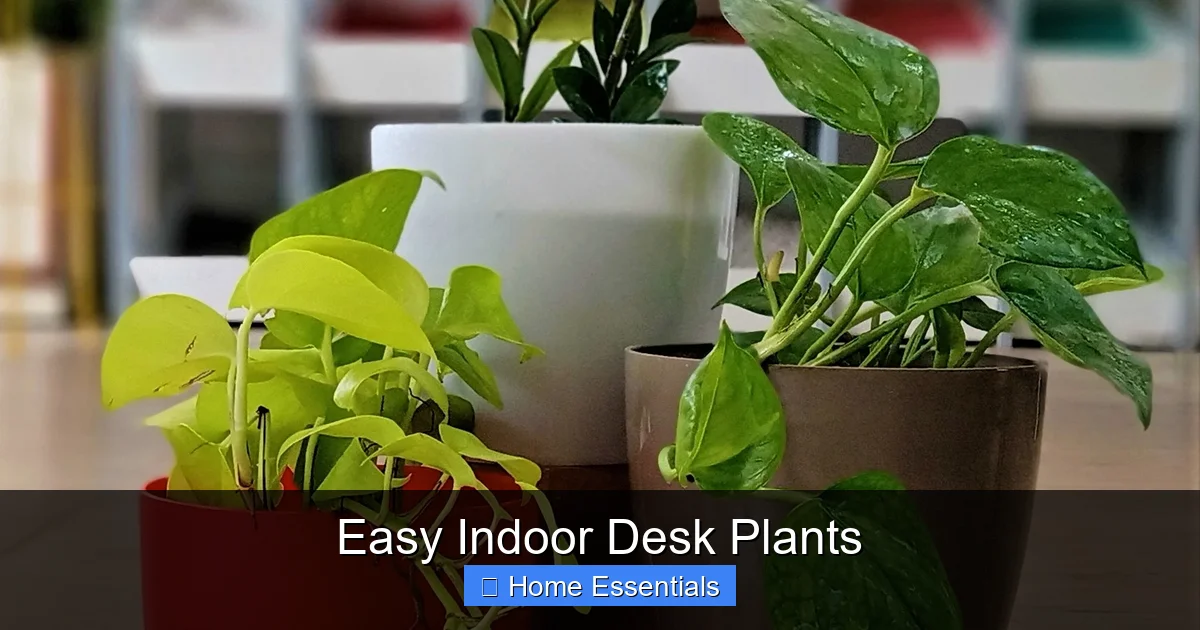
Think in Groups (Odd Numbers are Magic)
Grouping plants creates a mini-jungle vignette that feels curated. Use an odd number—3 or 5 small pots—of varying heights and textures. Place a Snake Plant (tall, linear) next to a ZZ Plant (glossy, arching) and a small Pothos (trailing). Use a common element like all white pots, all terra-cotta, or pots in a complementary color palette to tie them together. Group them on a corner of your desk, on a low stack of books, or on a small plant stand.
Go Vertical with Hanging & Wall-Mounted Options
Desk space is precious. Use your vertical space. A small hanging pot with a Spider Plant or a trailing Pothos suspended from a ceiling hook or a wall-mounted plant holder (like a Kokedama or a simple wall pocket) adds life without consuming any flat surface. A mounted staghorn fern is a spectacular, low-water option for a blank wall beside your desk.
Match the Vibe to Your Work
A creative freelancer might love the wild, trailing energy of a Pothos. A corporate lawyer might prefer the sleek, architectural lines of a Snake Plant or Cast Iron Plant. A teacher might enjoy the cheerful, baby-producing Spider Plant. Let your plant reflect your personal style and the energy you want in your workspace.
Pro Styling Tip: The Saucer Solution
To protect your desk surface from water damage, always place a saucer or drip tray under your pot. For a chic look, use a slate stone plate, a ceramic dish, or even a beautiful glass ashtray. It’s a simple step that prevents stains and looks purposeful.
Troubleshooting 101: What Your Plant is Saying
Even easy plants have off days. Don’t panic. Here’s a quick diagnostic guide for the most common issues.
Yellowing Leaves
This is the most common cry for help. Overwatering is the prime suspect, especially if the leaves feel soft and mushy. Check the soil moisture immediately. If the soil is soggy, let it dry out completely. Underwatering can also cause yellowing, but the leaves will typically feel dry and crispy. Assess your watering routine first.
Brown, Crispy Leaf Tips
This is usually a humidity or water quality issue. Our indoor air, especially with AC or heat, can be dry. Your plant’s leaf tips are the first to suffer. Mist the plant occasionally, or place it on a pebble tray (a shallow dish of pebbles and water) to increase local humidity. For Peace Lilies and Spider Plants, brown tips are often from fluoride in tap water. Switch to filtered or rainwater.
Leggy, Stretched-Out Growth
Your plant is reaching for light. It’s etiolating. Move it to a brighter location (still indirect light) or add a small grow light. Rotate it regularly. New growth should be compact and sturdy.
No New Growth
This isn’t always a problem. Many of these plants, especially the Snake Plant and ZZ, are naturally slow-growing, especially in low light. If it’s not losing leaves or looking unhealthy, it’s probably just happy being dormant. Ensure it’s not getting too cold (below 50°F/10°C) and that you’re not overwatering. Patience is key.
Pests: The Unwanted Guests
The most common desk plant pests are spider mites (tiny webbing on leaves) and mealybugs (white, cottony fluff). Isolate the plant immediately. For a minor infestation, wipe leaves with a cotton swab dipped in rubbing alcohol (isopropyl alcohol). For spider mites, give the plant a thorough shower in the sink or tub. Repeat weekly until pests are gone. Insecticidal soap is a safe, effective treatment.
Conclusion: Your Green Journey Starts Now
The world of easy indoor desk plants is welcoming and forgiving. It’s not about having a green thumb; it’s about having the right information and the right plant. Start with one—perhaps the indomitable Snake Plant or the communicative Peace Lily. Place it on your desk, follow the simple rules of drainage, appropriate light, and the touch-test for watering, and watch what happens.
You’ll notice a subtle shift. A moment of calm as you glance at its green form during a stressful call. A small sense of accomplishment when a new leaf unfurls. A cleaner breath of air in your personal space. This is the real magic. It’s not about creating a perfect Instagram backdrop; it’s about adding a living, breathing element of nature to your daily grind that gives back far more than it asks for. Your desk is your personal territory. Make it a sanctuary. Start with one easy plant, and let it grow on you.
Frequently Asked Questions
Can I really keep a plant alive with just artificial office light?
Yes, absolutely. Plants like the Snake Plant, ZZ Plant, and Pothos are exceptionally adapted to low, indirect light conditions. They photosynthesize efficiently under the spectrum of standard LED or fluorescent lights. Just ensure the light is on for a reasonable portion of the day (6+ hours) and avoid placing them in a completely dark corner with no light source at all.
How often should I actually water my desk plant?
Forget a calendar. The only reliable method is to check the soil. For Snake Plants and ZZ Plants, water only when the soil is completely dry—this could be every 3-6 weeks. For Peace Lilies and Pothos, water when the top inch of soil is dry—roughly every 1-2 weeks. Always water thoroughly and let it drain completely.
What’s the single biggest mistake people make with desk plants?
Without question, overwatering. It’s not that people water too often; it’s that they water without checking if the plant needs it, and they use pots without drainage holes. This combination leads to root rot, the #1 killer of houseplants. When in doubt, wait another week to water.
Do I need to fertilize my desk plant?
Not really, especially in the first year. Most plants come with enough nutrients in their potting mix. If you want to give it a boost during its active growing season (spring and summer), use a very diluted, balanced liquid fertilizer (half or quarter strength) once a month. For the slow-growing Snake Plant and ZZ, fertilizing once or twice a season is plenty. Do not fertilize in fall and winter.
My office is freezing in winter and hot in summer. Will my plant survive?
These plants are tolerant of typical indoor temperature swings (60-80°F / 15-27°C). The real danger is placing them in the direct line of an HVAC vent, where they’ll experience rapid drying from hot air or chilling from cold air. Keep them away from vents and drafty windows. A stable, moderate room temperature is perfect.
My plant has a few brown tips. Is it dying?
Probably not. A few brown leaf tips are usually a cosmetic issue, not a death sentence. It’s most commonly caused by low humidity or fluoride/chlorine in tap water. You can trim the brown tips off with clean scissors. Focus on improving watering practices (using filtered or overnight-sitting water) and consider occasional misting or a pebble tray. The plant will continue to grow new, healthy leaves.