How Many Watts Does a Desk Lamp Use
The wattage of a desk lamp depends entirely on its bulb type, ranging from a mere 4-6 watts for modern LEDs to 60 watts for old incandescent bulbs. LED lamps are the clear winners for energy efficiency, using up to 90% less power for the same light output. Your total cost is determined by wattage, hours of use, and your local electricity rate.
You plug in your trusty desk lamp, flip the switch, and a warm pool of light lands on your notebook. It’s a simple, everyday action. But have you ever wondered what’s happening behind the scenes? Specifically, how many watts does that desk lamp actually use? The answer isn’t a single number. It’s a story of technology, efficiency, and your electricity bill. Whether you’re a student burning the midnight oil, a remote worker crafting presentations, or an artist sketching into the early hours, understanding your lamp’s power draw is the first step to smarter, cheaper, and more sustainable lighting. Let’s shed some light on the subject, from the humble incandescent to the smartest LED.
Key Takeaways
- Wattage Varies by Technology: Incandescent bulbs use 40-100W, halogens 30-70W, while modern LEDs typically use only 4-20W for comparable brightness.
- Lumens, Not Watts, Measure Brightness: Watts measure energy use; lumens measure light output. Always compare lumens when shopping for bulbs.
- Energy Cost is Calculateable: Use the simple formula (Watts ÷ 1000) x Hours Used x Electricity Rate to find the cost of running your lamp.
- LEDs Offer Massive Savings: Switching from a 60W incandescent to a 9W LED saves about $7-$10 per year per lamp with typical use.
- Task Lighting Requires Less Power: A focused desk lamp needs far fewer lumens (and thus watts) than a room-filling overhead light.
- Smart Bulbs Add Features, Not Necessarily Wattage: Smart LED bulbs have similar wattages to standard LEDs but offer app control and scheduling for further savings.
- Check the Label: The lamp’s base or packaging often lists the maximum recommended bulb wattage for safety and to prevent overheating.
📑 Table of Contents
- Understanding Wattage: It’s Not About Brightness Anymore
- The Wattage Spectrum: What Your Lamp Actually Uses
- Calculating the Real Cost: From Watts to Dollars
- Choosing the Right Desk Lamp: Beyond Just the Bulb
- Smart Features: The Future of Desk Lighting
- Safety, Heat, and Long-Term Thinking
- Conclusion: Light Up Your Life the Smart Way
Understanding Wattage: It’s Not About Brightness Anymore
For decades, we bought bulbs based on watts. A 60-watt bulb was brighter than a 40-watt bulb. Simple. But with the rise of LED (Light Emitting Diode) technology, that rule is outdated. A watt is a unit of power—it measures how much energy a device consumes per second. Brightness is measured in lumens. An old 60-watt incandescent bulb produces about 800 lumens. A modern LED bulb can produce the same 800 lumens while using only about 9 watts. So, when asking “how many watts does a desk lamp use,” the real question is: “How many lumens do I need, and what’s the most efficient way to get them?”
The Great Divide: Incandescent vs. LED
This is the core of the matter. An incandescent bulb works by heating a tiny tungsten filament until it glows. This process is incredibly inefficient; about 90% of the energy is wasted as heat, not light. A halogen bulb is a more advanced incandescent, with a gas fill that extends filament life and slightly improves efficiency, but it still runs hot and wastes energy.
An LED is a semiconductor. When electricity flows through it, electrons move and emit light. Very little energy becomes heat. This fundamental difference is why LED wattages are so dramatically lower. For task lighting like a desk lamp, this efficiency is a game-changer. You get the focused light you need without the hot-to-the-touch bulb and the massive energy drain.
The Wattage Spectrum: What Your Lamp Actually Uses
Now, let’s get to the numbers. Here’s a breakdown of typical wattage ranges for different bulb types you’d find in a standard desk lamp. Remember, these are for the bulb itself; the lamp’s total draw is essentially the bulb’s wattage.

Visual guide about How Many Watts Does a Desk Lamp Use
Image source: storables.com
- Incandescent: 40W, 60W, 75W, 100W. These are the power-hogs. A 60W bulb is common for a general lamp, but it’s overkill for a focused task light and produces significant waste heat.
- Halogen: 35W, 50W, 65W. Slightly more efficient than incandescent, but still warm and power-hungry compared to LEDs. They often have a brighter, whiter light.
- Compact Fluorescent Lamp (CFL): 13W, 18W, 23W. These were the bridge technology between incandescent and LED. They’re efficient but contain mercury (requiring careful disposal), take time to warm up to full brightness, and aren’t ideal for frequent on/off cycles common with desk lamps.
- LED: 4W, 6W, 9W, 12W, 15W. This is the modern standard. A 9W LED replaces a 60W incandescent. A 12W LED replaces a 75W or 100W bulb. For most desk tasks, a 6W to 10W LED bulb provides more than enough light.
Practical Example: Your desk lamp has a single socket. If it currently has a 60W incandescent bulb, it’s using 60 watts. Swap it for a 9W LED with the same lumen output (look for ~800 lumens), and your lamp’s consumption drops by 51 watts instantly. That’s an 85% reduction in energy use for the same task lighting.
Calculating the Real Cost: From Watts to Dollars
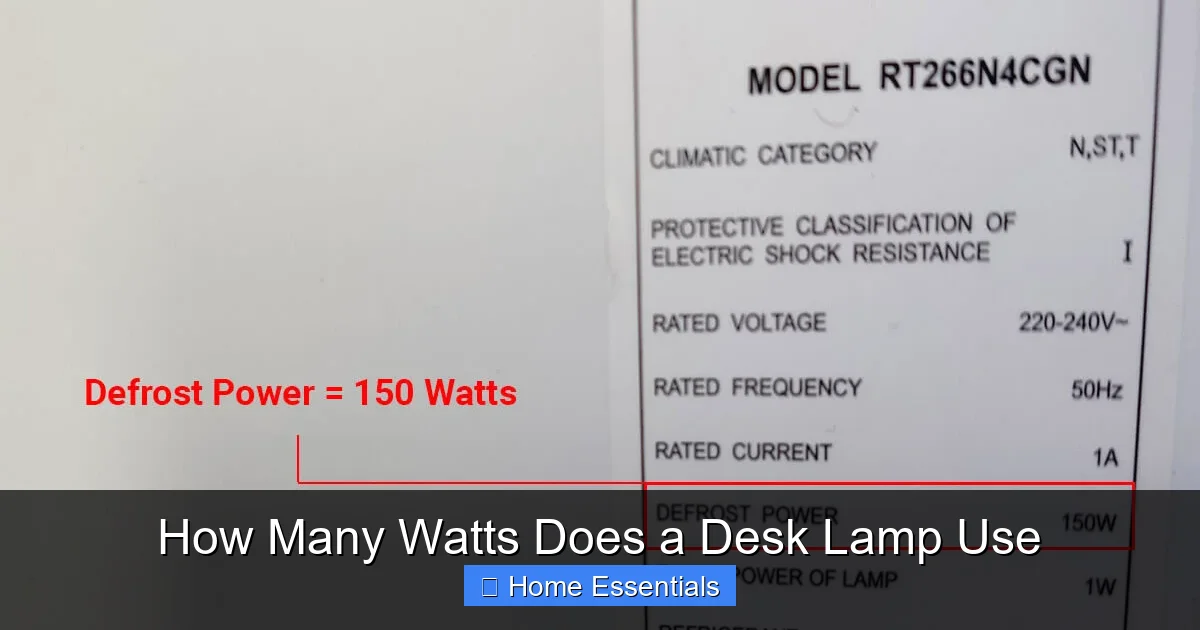
Knowing the wattage is step one. Step two is translating that into a tangible cost. The formula is delightfully simple:
Visual guide about How Many Watts Does a Desk Lamp Use
Image source: renewablewise.com
Cost = (Watts ÷ 1000) x Hours Used per Day x Days Used per Month x Your Electricity Rate (per kWh)
Let’s run two scenarios with a US national average electricity rate of ~16 cents per kWh.
Scenario A: The Inefficient Lamp
You use a 60W incandescent bulb in your desk lamp for 4 hours every weekday.
- Daily use: 60W / 1000 = 0.06 kW
- Daily cost: 0.06 kW x 4 hours x $0.16 = $0.0384
- Monthly cost (22 days): $0.0384 x 22 = **~$0.85 per month**
That seems low! But remember, that’s for one lamp. Now, multiply that by every inefficient bulb in your home.
Scenario B: The Efficient LED
Same usage (4 hours/day), but with a 9W LED bulb producing the same light.
- Daily use: 9W / 1000 = 0.009 kW
- Daily cost: 0.009 kW x 4 hours x $0.16 = $0.00576
- Monthly cost: $0.00576 x 22 = **~$0.13 per month**
The Savings: By switching one lamp, you save about $0.72 per month, or $8.64 per year. That pays for the cost of a new LED bulb in a few months. Now, consider your living room with five bulbs, your kitchen with ten. The savings compound quickly. This is why understanding wattage is directly tied to your household budget.
Choosing the Right Desk Lamp: Beyond Just the Bulb
The lamp itself matters. A well-designed lamp directs light where you need it, meaning you can use a lower-wattage (lower-lumen) bulb and still have perfect illumination. A poorly designed lamp scatters light, forcing you to use a brighter, higher-wattage bulb to compensate, wasting energy.
Visual guide about How Many Watts Does a Desk Lamp Use
Image source: thepowerall.com
Key Lamp Features for Efficiency
- Adjustable Arms & Heads: Look for multiple pivot points. This lets you aim the light precisely onto your keyboard or book, eliminating the need for overwhelming overall brightness.
- Shade Material & Design: A matte, opaque shade reduces glare and directs light downward. A shiny or perforated shade may scatter light inefficiently.
- Size Proportion: A massive lamp with a huge shade over a small desk is overkill. Match the lamp scale to your workspace.
- Built-in LED: Many modern desk lamps have the LEDs permanently integrated. You don’t change bulbs; the entire unit is designed for optimal heat dissipation and light direction. The wattage is fixed (e.g., 8W, 12W) but is almost always highly efficient. This is a fantastic set-and-forget option.
Pro Tip: When buying a new lamp, check if it’s “dimmable.” Dimmable LEDs paired with a compatible dimmer switch or touch control on the lamp base let you adjust brightness (and thus power use) to the exact level you need, saving even more energy.
Smart Features: The Future of Desk Lighting
This is where wattage meets convenience. Smart bulbs, which you can control via an app or voice assistant, are almost exclusively LED-based. Their base wattage is identical to a standard LED of the same brightness. A smart 800-lumen bulb will use about 9W, whether it’s on at 100% or scheduled to turn on at 50% brightness.
The real energy savings from smart bulbs come from their intelligence, not their inherent wattage. Features like scheduling (turn off automatically at 10 PM), motion sensing (turn on when you sit down), and geofencing (turn off when you leave home) prevent the “oops, I left the lamp on all night” scenario. If you’re interested in the technology, you can read more about how a smart bulb works. The key takeaway: a smart LED bulb doesn’t “use more electricity” because it’s smart; it uses the same efficient watts as a dumb LED, but helps you avoid waste. For a deep dive into their consumption, see how much energy smart bulbs consume.
Safety, Heat, and Long-Term Thinking
Wattage isn’t just about cost; it’s about safety. That 60W incandescent bulb in your enclosed desk lamp shade can get scorching hot. This poses a burn risk and, in rare cases, a fire hazard if the lamp’s materials are flammable or if the lamp is placed near papers or fabric. LEDs run cool to the touch even at full power, making them vastly safer for enclosed fixtures or cluttered desks.
Furthermore, consider lifespan. A quality LED bulb lasts 15,000-25,000 hours. An incandescent lasts about 1,000 hours. Over the life of one LED, you’d replace an incandescent bulb 15-25 times. This reduces waste and the hassle of changing bulbs in hard-to-reach fixtures. When evaluating total cost of ownership (purchase price + electricity + replacement bulbs), LEDs win every time.
Conclusion: Light Up Your Life the Smart Way
So, how many watts does a desk lamp use? The answer is: it’s your choice. You can choose the old way—a 60-watt heat generator that costs more to run and needs frequent replacement. Or you can choose the modern way: a 9-watt, cool-running, long-lasting LED that provides identical light for a fraction of the cost and hassle. The wattage of your lamp is no longer a fixed trait of the fixture; it’s a variable you control with your bulb choice. By understanding the relationship between watts, lumens, and your usage habits, you transform a simple desk lamp from an energy drain into a model of efficiency. Make the switch to LED, consider a lamp with good design, and maybe explore smart features for ultimate control. Your eyes, your wallet, and the planet will thank you for the brighter, smarter choice.
Frequently Asked Questions
Is a higher wattage bulb always better for a desk lamp?
No. Brightness is measured in lumens, not watts. A high-wattage incandescent bulb produces a lot of heat and glare, which can cause eye strain. For task lighting, you typically need 450-1000 lumens. A 9W LED provides 800 lumens, which is perfect for most desk work. Focus on lumens and a well-designed lamp that directs light, not just a high wattage.
Can I use a higher wattage LED bulb than my lamp’s rating?
No. The wattage rating on your lamp (e.g., “Max 60W”) is a safety limit based on heat dissipation. While an LED bulb uses far less actual power, its “equivalent wattage” (the incandescent brightness it replaces) can be misleading. Always check the bulb’s actual wattage (the small number on the bulb, e.g., 9W). As long as the bulb’s actual wattage is below the lamp’s max rating, you’re safe. A 9W LED is fine in a “Max 60W” lamp.
How many watts should a good reading lamp use?
For comfortable reading, you generally need about 500 lumens of focused light. An LED bulb using 6-8 watts will provide this. The key is a lamp that can be adjusted to shine directly on your book without causing glare or shadows. A lower-wattage LED in a great lamp is better than a higher-wattage bulb in a poor one.
Do smart bulbs use more electricity than regular LED bulbs?
No. Smart bulbs are built on LED technology. Their “on” state wattage is virtually identical to a standard LED bulb of the same brightness (e.g., a smart 800-lumen bulb uses ~9W). Their potential for energy savings comes from features like scheduling and remote control, which help prevent accidental all-night usage.
What’s the difference between a 9W and a 12W LED bulb for my desk?
The difference is brightness (lumens) and energy use. A 9W LED typically produces 800 lumens (good for general tasks). A 12W LED produces about 1000-1100 lumens (better for detailed work like drafting or art). Choose based on your need for brightness. The 12W will use slightly more electricity but still far less than any incandescent equivalent.
Can the wattage of my desk lamp affect my electricity bill significantly?
Individually, no. But collectively, yes. A single inefficient 60W lamp used 4 hours/day costs about $10/year to run (at average rates). The same light from a 9W LED costs about $1.50/year. If you have multiple lamps and other inefficient bulbs throughout your home, switching all to LED can save you $100-$200 annually. It’s the cumulative effect that makes a major impact on your bill.