What Is a Desk Study in Research
A desk study, also called secondary research, is a research method where you collect and analyze existing data from published sources rather than generating new primary data. It’s a cost-effective, time-efficient way to build background knowledge, identify gaps, and inform primary research design. By reviewing reports, studies, and datasets already available, researchers can quickly understand a topic’s landscape without fieldwork.
Key Takeaways
- Definition: A desk study uses pre-existing, published data and information to address research questions, avoiding new data collection.
- Core Purpose: Its primary goals are to contextualize a problem, review existing literature, and identify gaps for further primary research.
- Key Sources: Common sources include academic journals, government reports, industry whitepapers, market analyses, and reputable online databases.
- Major Advantage: It is significantly faster and less expensive than primary research methods like surveys or experiments.
- Key Limitation: The researcher is constrained by the quality, relevance, and timeliness of the available secondary data.
- Critical Skill: Success depends on strong analytical skills to synthesize, critique, and cross-verify information from diverse sources.
- Foundational Step: It is almost always the essential first phase in a comprehensive research project, laying the groundwork for primary investigation.
📑 Table of Contents
- What Exactly Is a Desk Study in Research?
- The Purpose: Why Every Research Project Starts at the Desk
- The Treasure Map: Types and Sources of Desk Study Data
- The Step-by-Step Blueprint: How to Conduct a Desk Study
- The Double-Edged Sword: Advantages and Limitations
- Desk Study in Action: Real-World Applications
- Pro Tips for an Effective Desk Study: Beyond the Basics
- Conclusion: The Indispensable First Step
What Exactly Is a Desk Study in Research?
Imagine you’re planning a major home renovation. Before you swing a hammer or call a contractor, what do you do? You research. You read blogs, watch videos, browse manufacturer websites, and study building codes. You’re gathering a wealth of existing information to inform your plan. That, in essence, is a desk study.
In the formal world of research, a desk study—often called secondary research—is the systematic process of collecting, analyzing, and synthesizing data that already exists. It’s research conducted from behind your desk, using resources published by others. This stands in direct contrast to primary research, where you go out into the world to gather fresh, first-hand data through surveys, interviews, experiments, or observations.
The fundamental principle is this: you are not creating new data; you are discovering, interpreting, and recombining existing knowledge. It’s the scholarly equivalent of a detective reviewing case files, a journalist combing through public records, or a business analyst poring over market reports. For anyone—from a student writing a thesis to a corporate strategist—mastering the desk study is a non-negotiable skill. It’s the foundation upon which all credible, efficient, and insightful research is built.
The Purpose: Why Every Research Project Starts at the Desk
You might wonder, if it doesn’t produce new data, what’s the point? The purpose of a desk study is profound and multi-layered. It’s not just a preliminary task; it’s the strategic engine that defines the entire research endeavor.

Visual guide about What Is a Desk Study in Research
Image source: cdn.shopify.com
1. To Map the Existing Knowledge Landscape
Before you can add a brick to the wall of human knowledge, you must know what that wall already looks like. A desk study creates a comprehensive map of what is already known about your topic. It answers: What theories dominate this field? What have other researchers found? What methodologies have been used? This prevents you from unknowingly “rediscovering” something already established and helps you stand on the shoulders of giants, as the saying goes.
2. To Identify the Crucial Gap
This is the most critical outcome. By thoroughly reviewing existing literature, you pinpoint what is not known, what questions remain unanswered, or what contradictions need resolving. This “gap” is the justification for your own primary research. It defines your unique contribution. Without a desk study, you risk pursuing a question that has already been answered or is simply uninteresting to your field.
3. To Inform and Refine Your Methodology
Why reinvent the wheel? A desk study shows you how others have successfully (or unsuccessfully) studied similar questions. You learn which measurement tools are validated, which sampling strategies work, and what pitfalls to avoid. You might discover that a specific survey instrument, like a well-established psychological scale, is perfect for your needs, saving you months of development time. It’s like checking the compatibility chart for smart bulbs before you buy—it ensures your research “fixture” will work with your chosen “system.”
4. To Build a Theoretical Framework
Your research needs a conceptual lens—a set of theories and concepts that guide your inquiry. A desk study is where you find and assemble this framework. You extract key theories, models, and definitions from existing sources to construct the intellectual scaffolding for your own work. This gives your research coherence and connects it to the broader academic conversation.
The Treasure Map: Types and Sources of Desk Study Data
Not all existing data is created equal. A skilled researcher knows where to dig for gold and where to find only fool’s gold. Desk study data generally falls into two categories, each with its own universe of sources.

Visual guide about What Is a Desk Study in Research
Image source: mindthegraph.com
Internal vs. External Data
Internal Data is generated within an organization. For a business, this includes sales reports, website analytics (like Google Analytics), customer relationship management (CRM) databases, internal memos, and previous project reports. It’s incredibly specific to your context but may have limited generalizability. For a student, internal data might be a university’s own enrollment statistics or alumni surveys.
External Data comes from outside your immediate organization. This is the vast, publicly available world of information and includes:
- Academic & Scholarly Sources: Peer-reviewed journal articles (found on PubMed, JSTOR, Google Scholar), doctoral dissertations, and academic books. These are the gold standard for credibility in scientific research.
- Government & Institutional Sources: Census data, national health statistics, economic indicators from treasury departments, EPA reports, and UNESCO data. These are typically highly reliable and comprehensive.
- Commercial & Industry Sources: Market research reports from firms like Gartner, Forrester, or Mintel; trade association publications; and business news from outlets like the Financial Times or Bloomberg. These are vital for business and marketing research.
- Professional & NGO Sources: Reports from think tanks (e.g., Brookings Institution), international bodies (WHO, World Bank), and non-profits (Red Cross, WWF).
- Digital & Media Sources: Reputable news articles, documentaries, white papers, and even curated social media trends (with caution regarding verification). The key is evaluating the publisher’s authority.
Think of these sources like different tools for cleaning. You wouldn’t use a rough rag on a delicate lens. Similarly, you match the source to your need. For a national demographic trend, census data is your precision instrument. For a quick understanding of consumer sentiment, a recent industry report might suffice.
The Step-by-Step Blueprint: How to Conduct a Desk Study
Conducting a desk study isn’t just Googling and copying. It’s a structured, investigative process. Here is a practical, step-by-step blueprint.
Visual guide about What Is a Desk Study in Research
Image source: helpfulprofessor.com
Step 1: Define Your Scope and Questions with Precision
You begin not with a search, but with a question. A vague question like “Tell me about smart homes” will yield a chaotic, unusable flood of information. A precise question like “What are the adoption rates and primary barriers to smart lighting adoption among urban homeowners in Germany between 2020-2023?” immediately focuses your search. Define your key concepts (e.g., “smart lighting,” “adoption rates,” “barriers”) and your boundaries (geographic, temporal, demographic).
Step 2: Identify and Access Your Sources Strategically
Based on your question, list the most likely sources. For the smart lighting question, you’d target:
- German government statistical offices (Destatis).
- European Union digital economy reports.
- Market research firms covering the European smart home market.
- Academic databases for studies on technology adoption models (like the Technology Acceptance Model).
Access these through university libraries (if you’re affiliated), public libraries, or direct publisher websites. Many government sources are free; commercial reports can be expensive, so look for executive summaries, press releases citing them, or news articles that analyze them.
Step 3: Search, Screen, and Save Systematically
Use advanced search techniques. In Google Scholar, use specific phrases in quotes, the “site:” operator to search a specific domain (e.g., `site:.gov`), and date range filters. Develop a simple screening criteria: Is this source credible? Is it relevant to my specific question? Is it recent enough (considering the field’s pace)? Save everything you find potentially useful in a reference manager like Zotero, Mendeley, or even a well-organized cloud folder with a clear naming convention (Author_Year_Title).
Step 4: Analyze, Synthesize, and Critique
This is the intellectual heavy lifting. Don’t just summarize each source in isolation. Read actively with these questions in mind:
- What is the main argument or finding?
- What methodology did they use? Is it sound?
- What are the limitations the authors themselves mention?
- How does this source agree or conflict with others I’ve read?
- What does this mean for my specific research question?
Synthesis is the art of weaving these threads together. You might create a thematic table: “Theme 1: Cost Barriers,” listing findings from 5 different reports. Or a chronological timeline showing how the concept of “smart home” has evolved in media discourse. You are looking for patterns, trends, contradictions, and consensus.
Step 5: Document Meticulously and Avoid Plagiarism
From the very first note you take, record the full citation. It is impossible to reconstruct later. Note the exact page number for any direct quote or specific data point. Your final write-up will include a reference list. Paraphrase ideas in your own words and always cite the original source. Plagiarism is the cardinal sin of research, and it often stems from poor note-taking.
The Double-Edged Sword: Advantages and Limitations
A desk study is a powerful tool, but like any tool, it has specific uses and inherent constraints. Understanding its pros and cons is key to using it effectively.
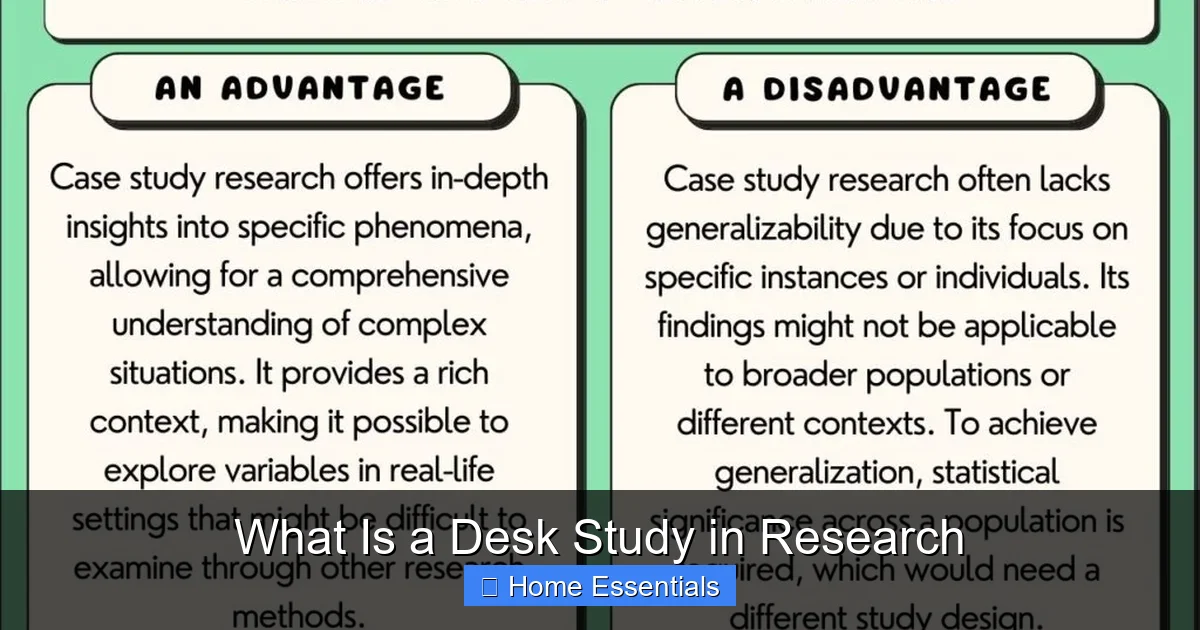
Advantages: Speed, Breadth, and Cost-Effectiveness
The benefits are compelling. It is fast. You can gather a vast amount of information in days or weeks, not months or years. It is inexpensive. Your main costs are your time and access to libraries or databases, not travel, participant incentives, or equipment. It provides breadth. You can get a macro-level view of a field, seeing the “big picture” that a single primary study, focused on a narrow question, cannot provide. It’s perfect for background work, feasibility studies, and policy analysis. For instance, before investing in developing a new smart light bulb, a company would conduct an extensive desk study on existing patents, competitor products, and consumer reviews to assess market viability.
Limitations: The Tyranny of Existing Data
The limitations are equally important. You are not in control. The data was collected for someone else’s purposes, which may not align perfectly with yours. You can’t ask follow-up questions. Quality varies wildly. Not all published sources are credible or unbiased. A blog post is not a peer-reviewed journal. It may be outdated. In fast-moving fields like tech or medicine, a study from five years ago might be obsolete. It can be incomplete. The data you need might simply not be publicly available or might be held privately. Finally, it can lead to circular reasoning. If all sources cite the same original, flawed study, you might perpetuate an error without realizing it. This is why cross-verification with multiple, independent sources is a mandatory step.
Desk Study in Action: Real-World Applications
This method isn’t confined to academia. Its applications are ubiquitous across sectors.
In Academia and Graduate Research
Here, it is synonymous with the “literature review.” A PhD student’s desk study might consume the first year of their program, resulting in a comprehensive review article that establishes their expertise and defines their dissertation’s original contribution. It answers: What is the state of the art in quantum computing error correction? What theories explain urban migration patterns in the 21st century?
In Business and Market Strategy
A startup wants to enter the eco-friendly cleaning products market. Its desk study involves: analyzing Euromonitor reports on the global market size and growth, reviewing patents for new biodegradable surfactants, scraping and analyzing Amazon reviews of top-selling products to identify customer complaints, and studying sustainability reports from major competitors like Unilever. This informs their product development, pricing, and positioning strategy before a single prototype is made. They might also analyze consumer reports on why microfiber cloths are preferred for cleaning to understand material science preferences.
In Public Policy and Non-Profit Work
A city council wants to reduce homelessness. Their desk study compiles: HUD (U.S. Department of Housing and Urban Development) point-in-time count data, academic studies on the effectiveness of “Housing First” models, reports from local non-profits on service gaps, and comparative case studies of cities that have successfully reduced homelessness. This evidence base is crucial for drafting a data-driven, defensible policy proposal.
In Journalism and Content Creation
A journalist writing an investigative piece on the safety of smart home devices will desk study: FCC compliance filings, consumer safety incident databases, expert testimony from congressional hearings, and technical analyses from cybersecurity firms. This builds the factual backbone of their story, allowing them to ask sharper questions of sources and present a well-rounded report.
Pro Tips for an Effective Desk Study: Beyond the Basics
To move from competent to excellent, incorporate these advanced practices.
Start with a “Snowball” Approach
Once you find 3-5 truly seminal, high-quality sources (often called “cornerstone” or “foundational” texts), use their reference lists. This “backward snowballing” is a classic technique to find key prior work you may have missed. Then, use Google Scholar to see who has cited those seminal works since publication (“forward snowballing”). This efficiently maps the intellectual lineage of your topic.
Create an Evidence Matrix
Don’t let information swirl in your head. Create a simple spreadsheet (an evidence matrix). Columns might be: Author/Year, Research Question, Methodology, Key Findings, Limitations, Relevance to My Question. This forces you to engage analytically with each source and creates a single, searchable document that becomes the raw material for your literature review. It visually reveals where studies agree, conflict, or leave gaps.
Beware of Bias and Seek Disconfirming Evidence
Confirmation bias is the siren song of desk research. You’ll naturally be drawn to sources that support your pre-existing hypothesis. Actively fight this. When you find a compelling source arguing “X,” deliberately search for reputable sources arguing “not-X.” Engage with the strongest counter-arguments. This doesn’t mean giving equal weight to fringe views, but it does mean understanding the full spectrum of expert debate on your topic.
Know When to Stop
Desk research can be a bottomless pit. You can always find one more article, one more report. Define your stopping point criteria. It might be: “I am no longer finding new, significant themes; I am only finding repetitions of existing points.” Or, “I have a clear gap identified and enough background to design my primary study.” The goal is sufficiency and relevance, not comprehensiveness (which is often impossible).
Conclusion: The Indispensable First Step
A desk study is far more than a perfunctory literature review. It is the strategic reconnaissance mission that precedes any major research expedition. It demystifies the terrain, reveals hidden obstacles, and points toward the most promising path forward. It transforms you from someone with a vague curiosity into a researcher with a sharp, justified, and original question.
By mastering the disciplined art of finding, evaluating, and synthesizing existing knowledge, you save immense amounts of time and resources. You ensure your primary research is targeted, meaningful, and built upon a solid foundation. Whether you’re a student drafting a thesis proposal, an entrepreneur validating a business idea, or a policy analyst drafting a briefing, your research journey must begin at the desk. It is the single most important step you can take to ensure your final work is credible, valuable, and truly contributes something new to the world. Remember, in research, knowing what is already known is the first and most critical step to discovering what is not.
Frequently Asked Questions
What is the main difference between a desk study and field research?
A desk study analyzes existing, secondary data collected by others, while field research (primary research) involves collecting new, first-hand data directly from sources through methods like surveys, interviews, or experiments. The desk study comes first to inform the design of the field research.
How long should a desk study take?
The duration varies widely based on the topic’s complexity and the research’s scope. For a simple business report, it might take a few days. For a doctoral literature review, it can take several months. A good rule of thumb is to continue until you can clearly articulate the existing knowledge and identify a specific, justified gap your research will address.
Can I rely solely on a desk study for my research project?
It depends entirely on your research question. If your question can be fully answered by analyzing existing, high-quality data (e.g., “What were the trends in U.S. internet penetration from 1995-2005?”), then a desk study may suffice. However, most original research projects require primary data collection to investigate a new gap or test a new hypothesis in a specific context.
What is the biggest mistake people make in a desk study?
The biggest mistake is failing to critically evaluate sources. Not all information is equal. Relying on biased blog posts, outdated statistics, or non-peer-reviewed sources undermines the entire study’s credibility. Always assess the author’s credentials, the publication’s reputation, the date, and the methodology behind any data presented.
How do I know if a source is credible for my desk study?
Look for these markers: Is it published by a reputable entity (academic press, government agency, established journal)? Is it peer-reviewed? Does the author have relevant expertise and affiliations? Is it recent enough for your topic? Are references provided? Is the tone objective and balanced, or is it clearly promotional or polemical? When in doubt, consult a librarian or subject expert.
Is a desk study qualitative or quantitative?
It can be either, or a mix of both (mixed-methods). A quantitative desk study might involve analyzing existing statistical datasets from the World Bank. A qualitative desk study might involve a thematic synthesis of interview transcripts from published case studies. The “secondary” nature refers to the data source, not the analytical approach.