Where Should a Study Desk Be Placed
Placing your study desk correctly is crucial for focus, comfort, and productivity. The ideal spot balances natural light, minimizes distractions, and supports good posture. Avoid placing your desk directly in front of a window or against a wall with high traffic. Instead, aim for a position perpendicular to the window with a clear view of the room’s entrance for a sense of security and control over your study environment.
You’ve invested in a great desk, a comfortable chair, and all the stationery you could need. But if your desk is in the wrong spot, all that investment might not pay off. The physical location of your study desk within a room is one of the most overlooked yet powerful factors influencing your ability to concentrate, retain information, and work comfortably for hours. It’s not just about finding an empty square of floor space; it’s about understanding environmental psychology, ergonomics, and simple practical logistics. This guide will walk you through the science and art of placing your study desk to create the ultimate productivity sanctuary in your home.
Key Takeaways
- Lighting is Paramount: Position your desk to use natural side light from a window, avoiding direct glare on your screen or papers.
- Face the Room’s Entrance: Sitting with your back to the door can cause subconscious stress; a view of the entrance promotes a sense of safety and focus.
- Prioritize Ergonomics: Ensure your desk placement allows for an adjustable chair, proper monitor height, and enough space to stretch your legs.
- Minimize Visual & Auditory Distractions: Avoid placing your desk in high-traffic areas, directly facing busy hallways, or against walls with TVs or clutter.
- Consider Power & Cable Management: Plan your desk location near power outlets to avoid tripping hazards and unsightly cord sprawl across walkways.
- Think About Room Function: In a multi-use room, use furniture, screens, or room dividers to create a dedicated “study zone” that psychologically signals work mode.
- Personal Preference Matters: Some people thrive in a quiet corner, others with a bit of ambient noise. Experiment to find what truly helps *you* concentrate.
📑 Table of Contents
The Golden Rules of Desk Placement: Light, View, and Flow
Before diving into specific room layouts, there are three universal principles that apply to almost any space. These are the non-negotiables of a good study setup. Think of them as the foundation upon which you build your perfect workspace.
Rule 1: Master the Light (Natural and Artificial)
Lighting is your single most important environmental factor. Poor lighting causes eye strain, headaches, and fatigue. Good lighting keeps you alert and makes reading and writing easier. The goal is to have your primary light source come from the side, not from in front or behind you.
Natural Light Strategy: The best position is with a window to your side. This provides even, diffused light across your workspace without creating glare on your computer screen (which happens if the window is directly in front of you) or casting your shadow over your work (which happens if the window is directly behind you). If you have a window, place your desk so the window is on your left or right side. Use sheer curtains or blinds to diffuse harsh direct sunlight.
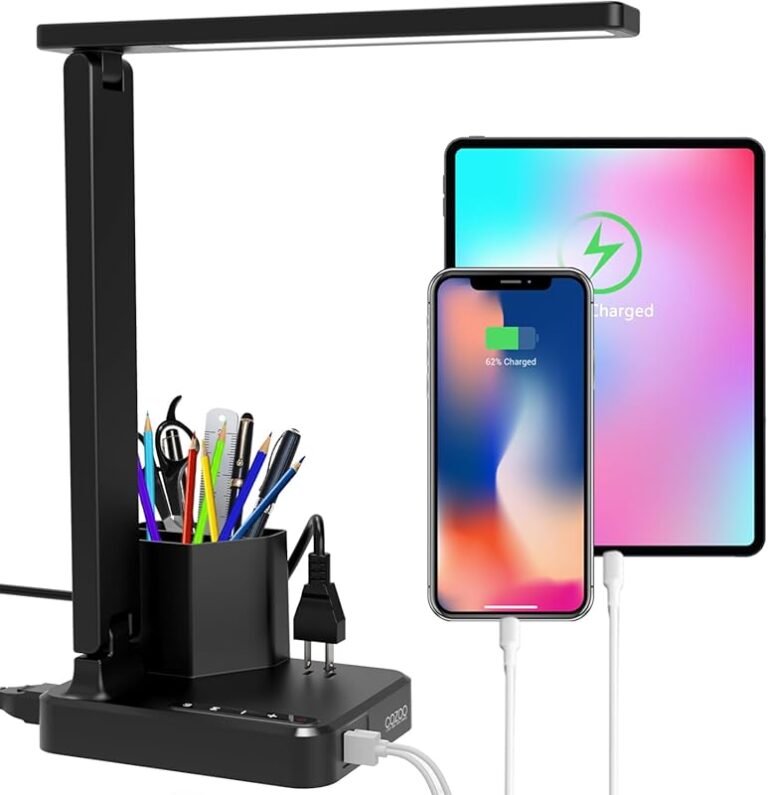
Artificial Light Strategy: Your desk lamp is your best friend for evening study sessions. Position it on the opposite side of your writing hand to avoid casting shadows (e.g., if you’re right-handed, put the lamp on the left side of your desk). The lamp should illuminate your entire desk surface without shining directly into your eyes. For task lighting, look for a lamp with adjustable brightness and color temperature. Warmer tones are relaxing, cooler, daylight-like tones (around 5000K) are better for focus. If your room’s overhead lighting is the only source, ensure it’s bright enough and consider a desk lamp as a supplement. Proper lighting is so critical that it even affects how you perceive your microfiber cloth when cleaning your desk surface; good light reveals dust and smudges you’d otherwise miss.
Rule 2: Command the Room (The “Power Position”)
This comes from interior design and feng shui: you want to sit in a position where you can see the entrance to the room without having to turn around completely. This is often called the “command position” or “power position.” When your back is to the door, your subconscious mind remains slightly alert, listening for people entering. This low-grade stress drains mental energy needed for deep study. By having a clear line of sight to the door (even if it’s just a glimpse in a mirror or through a hallway), you signal to your brain that you are aware of your surroundings and safe, allowing for greater relaxation and concentration. If the room layout makes this impossible, consider a small mirror on your monitor or desk to see behind you.
Rule 3: Respect the Flow (Minimize Distractions)
Consider the natural traffic patterns in your home. Your desk should not be in a main walkway where people constantly pass behind you. This creates visual and auditory interruptions that break your flow state. Similarly, avoid placing your desk directly facing a TV, a busy street window, or a cluttered wall. Your brain will inevitably be drawn to movement and chaos. Create a buffer zone. If your room is a multi-purpose space like a living room or bedroom, use a room divider, a tall plant, or a bookshelf to create a physical and psychological barrier between your study zone and the rest of the room’s activity. This helps your mind switch into “work mode” the moment you sit down.
Room-by-Room Desk Placement Guide
Now let’s apply these golden rules to the specific rooms where you might set up a study desk. Each space has its own opportunities and challenges.

Visual guide about Where Should a Study Desk Be Placed
Image source: cdn.autonomous.ai
The Dedicated Home Office
This is the easiest scenario! You have a room solely for work or study. Here, your primary goal is optimal ergonomics and maximizing the room’s best features.
- Best Spot: Place your desk in the middle of the longest wall, or centered on a wall opposite the door (so you see the door). If there’s one exceptional window, place the desk perpendicular to it on either side.
- Avoid: Don’t push the desk all the way into a corner. This creates a cramped feeling and limits your ability to move your chair and stand up easily. Leave at least 24-30 inches of space behind the desk for your chair to roll and for you to stand up comfortably. Also, avoid placing it under a window if you have a tall chair, as you might block the light or feel a draft.
- Pro Tip: In a small office, a wall-mounted floating desk can free up floor space and make the room feel larger. Just ensure the wall is solid and can support the weight.
The Bedroom Study Nook
Many students and remote workers use a bedroom. The challenge here is separating sleep from study to maintain good sleep hygiene.
- Best Spot: The best location is on a wall that is not directly opposite or beside your bed. Ideally, place the desk so when you’re sitting at it, you are not facing your bed. This visual separation helps your brain not associate the desk with relaxation. A corner that is diagonally across from the bed is often ideal. Ensure you still have a view of the bedroom door.
- Avoid: Never place your desk on the same wall as your bed if you can help it, and especially not with your back to the bed. This makes the bed a constant visual distraction. Also, avoid putting it in a spot where morning sun will wake you up prematurely if you like to sleep in.
- Pro Tip: Use a folding screen or a curtain to temporarily hide the bed when it’s study time. Ensure your task lighting is separate from your bedroom’s ambient lighting so you can work late without disturbing a sleeping partner.
The Living Room or Open-Plan Space
This is the most challenging but common scenario. The key is creating a defined, dedicated zone.
- Best Spot: Look for a corner that feels slightly removed from the main seating area. A corner near a window is perfect. Use the room’s architecture to your advantage—place the desk behind a sofa, or in a nook created by a bay window. The back of the desk should face into the room (so you see the main activity), not toward a wall, to maintain a sense of openness and allow you to see who’s entering the space.
- Avoid: Don’t put the desk in the center of the room’s main flow path. Don’t place it so it’s the first thing you see when you walk in, making the space feel like a “work zone” immediately. Avoid putting it under a TV or directly in front of a main seating area.
- Pro Tip: Invest in a room divider that doubles as storage (like a bookshelf) or a tall, leafy plant. This creates a visual wall. A consistent, high-quality microfiber duster becomes essential here to quickly clean dust from your desk and the divider, as open-plan spaces collect more dust.
Ergonomic Considerations Beyond Location
Finding the spot is step one. Step two is setting up that spot correctly for your body. A poorly arranged desk, even in a perfect location, will lead to discomfort.
Visual guide about Where Should a Study Desk Be Placed
Image source: cdn.autonomous.ai
The Chair and Desk Height Relationship
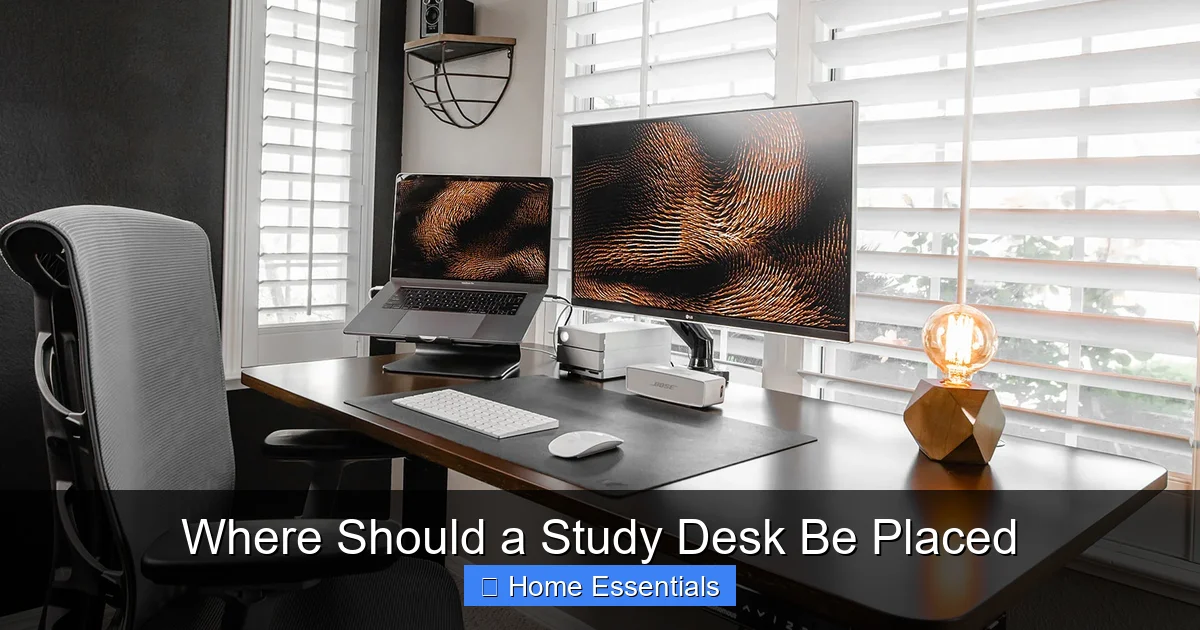
Your feet should rest flat on the floor (or on a footrest) with your knees at a 90-degree angle. Your elbows should be at a 90-degree angle when typing, with your forearms parallel to the floor. Your monitor should be at or just below eye level, about an arm’s length away. This setup prevents neck, shoulder, and back pain. An adjustable chair is non-negotiable for long-term health. If your desk is too high or too low, you will strain regardless of its location in the room.
Managing Cables and Power
This is a practical nightmare if not planned. Before finalizing your desk location, identify the nearest power outlet(s). You need enough outlets for your computer, monitor, lamp, and phone charger. Use cable clips, sleeves, or a cable management box to keep cords from dangling and creating a tripping hazard or an eyesore. A power strip under the desk with a long cord can be a lifesaver. Plan your cable route—will it run along the baseboard or down the back of the desk leg? A clean cable setup makes the space feel more peaceful and professional.
The Psychology of Placement: Creating a Mental Trigger
Your brain is a pattern-recognition machine. You can use your desk’s location to create a powerful psychological trigger for focus. The goal is to make the act of walking to your desk a cue for your brain to enter “study mode.”

Visual guide about Where Should a Study Desk Be Placed
Image source: cdn.autonomous.ai
- Consistency is Key: Always study at the same desk, in the same spot. This builds a strong association.
- Separate from Relaxation: If possible, do not use your study desk for gaming, browsing social media, or watching movies. This keeps its purpose pure in your mind.
- Control the Environment: The act of adjusting your chair, turning on your specific task lamp, and organizing your materials should be a ritual that signals the start of a work session. The physical space itself, once optimized, becomes part of that ritual.
- Sensory Cues: Consider a specific, subtle scent you use only at your desk (a particular essential oil on a cotton ball, a scented candle you only light while studying). Over time, that smell can trigger focus.
Special Considerations and Troubleshooting
What if you have constraints? Here’s how to handle common problems.
Small Spaces & Studio Apartments
You must be ruthless about multi-functionality. A wall-mounted drop-leaf desk or a narrow console desk that doubles as a vanity is ideal. Use vertical storage on the wall above the desk (shelves, pegboards) to keep the surface clear. When not in use, the desk area should be completely clear to restore the room’s primary function (living/sleeping). A microfiber cloth stored in a drawer nearby makes it quick to wipe down the surface before converting the space back.
Shared Spaces and Roommates/Family
Communication is your biggest tool. Establish “quiet hours” or a signal (like a specific lamp being on) that means “do not disturb.” If noise is an issue, invest in good noise-canceling headphones. For visual distractions, the room divider is your best friend. Make your desk area so neat and organized that it doesn’t contribute to shared space clutter, which can cause tension.
The “Awkward Room” Problem
Rooms with many doors, windows on all walls, or unusual shapes are tough. In this case, prioritize the “command position” (seeing the main entrance) and best light source, even if it’s not perfect. You might have to compromise. Use the room’s features creatively. Could a bookshelf create a makeshift wall to place your desk against? Can you hang heavy curtains to block a distracting window view while still letting light in? Sometimes, the “good enough” spot, optimized with excellent lighting and organization, is better than obsessing over a perfect, unattainable spot.
Conclusion: Your Desk, Your Rules
Ultimately, the best place for your study desk is the place where you can consistently be your most productive and comfortable self. The guidelines above are based on environmental psychology and ergonomic science, but your personal preference is the final judge. Do you concentrate better with a bit of background hum, or do you need pin-drop silence? Do you feel energized by a view of trees, or distracted by people walking by? The only way to know for sure is to experiment. Try different spots for a week each. Take note of your energy levels, focus duration, and physical comfort. The perfect spot is out there—it just takes a little observation, a few adjustments, and a commitment to creating a space that respects both your mind and your body. Now, go find it, set it up, and watch your productivity soar.
Frequently Asked Questions
Should my desk face the wall or the window?
Ideally, your desk should be placed perpendicular to the window, with the window on your left or right side. Facing the window causes glare on your screen, while having your back to it casts your shadow on your work. A side-facing position provides optimal, even light.
Is it bad to put a desk under a window?
It can be. A window directly above your desk can cause glare on your screen, create distracting views outside, and may lead to a draft or excessive heat from the sun. If this is your only option, use high-quality blinds or curtains to control the light and consider a monitor hood to block glare.
What is the best direction for a study table according to Vastu or Feng Shui?
Can I put my desk in a closet?
Yes, a closet can be transformed into an excellent “study nook” or “cloffice.” It provides a completely enclosed, distraction-free zone. The key is ensuring adequate ventilation, lighting (both natural if possible and a strong task lamp), and enough space for your chair to pull out comfortably. Insulate it from noise if possible.
How much space should be behind my desk?
You should have at least 24-30 inches (about 60-75 cm) of clear space behind your desk. This allows you to push your chair back, stand up easily, and move around without backing into a wall or furniture. This clearance is crucial for ergonomic movement and comfort.
My room is too small for a separate desk. What are my options?
Consider a wall-mounted floating desk, a narrow console table, a fold-down wall-mounted desk, or a desk that is part of a Murphy bed system. The key is choosing a solution that can be cleared away when not in use to maintain the room’s primary function. Use vertical wall storage to keep supplies off the limited surface area.