Will a Desk Lamp Help Plants Grow
Yes, a desk lamp can help certain plants grow, but with major caveats. It primarily depends on the lamp’s light spectrum, intensity, and how long it runs. Standard desk lamps often lack the full spectrum and high intensity of dedicated grow lights, making them suitable only for low-light tolerant plants or as a temporary supplement. For most edible plants or vibrant blooms, a proper grow light is necessary for healthy, robust growth.
You’ve got a favorite desk lamp, the one with the flexible neck and the soft glow that’s perfect for reading. You also have a sad-looking houseplant on your desk, stretching toward the window. A simple thought pops up: can I just point my desk lamp at it? Will a desk lamp help plants grow? It’s a brilliant, logical question that sits at the intersection of practicality and plant parenthood. The short answer is: sometimes, but with a lot of important “buts.” The longer, more helpful answer is what we’re diving into today. Let’s unpack the science of light, the limitations of your average lamp, and exactly how to make this work—if it’s even possible for your specific plant and goals.
First, let’s ditch the myth that all light is equal for plants. The light you use to read a book is not the same as the light a plant uses to photosynthesize. Plants are like solar-powered factories. They absorb specific wavelengths (colors) of light, primarily in the blue and red spectrums, to convert carbon dioxide and water into sugars for growth. The light from a standard incandescent bulb is mostly in the yellow-green spectrum, which plants reflect—hence why things look green under that light. It’s inefficient for them. So, the type of bulb in your desk lamp is the very first, non-negotiable factor. We’ll break down all these factors—spectrum, intensity, duration, and plant type—to give you a clear, actionable guide.
Key Takeaways
- Spectrum is critical: Plants need blue and red light spectrums for photosynthesis. Many standard desk lamps (especially incandescent) provide poor spectrum, while full-spectrum LED bulbs are a viable option.
- Intensity (PPFD) matters: Desk lamps typically deliver low light intensity (measured in PPFD). This is only sufficient for low-light plants like pothos or snake plants, not for fruiting vegetables or flowering plants.
- Distance and duration are key: A desk lamp must be placed very close (6-12 inches) and run for 12-18 hours daily to have any meaningful effect, which can create heat or space issues.
- Not all plants are equal: Low-light, foliage-only plants can sometimes survive with a strong desk lamp. Plants that flower or produce fruit have much higher light demands a desk lamp cannot meet.
- Heat and safety: Older incandescent or halogen desk lamps generate significant heat, risking plant burns or fire hazard. Cool-running LEDs are the only safe choice for close, prolonged use.
- It’s a supplement, not a replacement: A desk lamp is best used to boost light for a plant already near a window, not as its sole light source in a dark room.
- Cost-effectiveness is low: While using an existing lamp seems cheap, inefficient bulbs cost more in electricity and may stunt plant growth, leading to wasted time and money.
📑 Table of Contents
- Understanding What Plants Really Need From Light
- Desk Lamp vs. Dedicated Grow Light: A World of Difference
- Which Plants Can Actually Survive (and Thrive?) Under a Desk Lamp?
- How to Optimize Your Desk Lamp for Plants (If You Must Try)
- When to Upgrade to a Real Grow Light: Clear Warning Signs
- Conclusion: The Honest Verdict on Desk Lamps and Plant Growth
Understanding What Plants Really Need From Light
Before we judge your desk lamp, we need to understand the judge’s criteria: the plant’s needs. It’s not just about “light on” or “light off.” There are three core pillars: Spectrum, Intensity, and Photoperiod.
The Magic Spectrum: Blue for Leaves, Red for Flowers
Imagine light as a rainbow. Plants have special pigments, chlorophyll a and b, that act like solar panels tuned to specific colors. Chlorophyll a absorbs best in the blue-violet and red-orange parts of the spectrum. Chlorophyll b broadens this, soaking up more blue and some red. This is why a healthy plant under a full-spectrum light looks vibrant—it’s getting the balanced diet it craves. Blue light (400-500 nm) is crucial for vegetative growth, promoting strong stems, healthy leaf development, and compact, sturdy plants. Red light (600-700 nm) is the trigger for flowering and fruiting. A light that’s heavy on just one spectrum will lead to imbalanced growth—lots of spindly leaves with no flowers, or weak stems trying to chase a light source. Your desk lamp’s bulb determines where it falls on this spectrum.
Intensity: How “Strong” Is the Light? (PPFD Explained)
Intensity is how many light particles (photons) actually reach the plant’s leaves per second. We measure this in PPFD (Photosynthetic Photon Flux Density), in units of micromoles per square meter per second (μmol/m²/s). This is the most important number for growers, but it’s rarely on a lamp box. A sunny summer day outdoors can be 2000+ PPFD. A bright office might be 200-500 PPFD. A typical, decent LED desk lamp held 12 inches above a plant might only provide 50-150 PPFD, depending on its wattage and design. Low-light plants like the cast-iron plant can survive on 50-100 PPFD. Medium-light plants like a peace lily prefer 200-400. High-light plants like tomatoes or peppers need 500+ PPFD. Your desk lamp’s intensity is almost always in the low-light range, at best.
Photoperiod: The Unseen Clock
Plants also rely on the length of their dark period to regulate flowering (this is called photoperiodism). For our purpose of just “growing,” the rule is simple: most vegetative growth happens with 12-18 hours of light per day, followed by 6-12 hours of uninterrupted darkness. A timer is your best friend here. A desk lamp left on 24/7 will confuse and stress most plants, even if the spectrum and intensity were perfect. Consistency is key.
Desk Lamp vs. Dedicated Grow Light: A World of Difference
Now, let’s compare your humble desk lamp to a purpose-built LED grow light. The gap is wider than you might think.
Visual guide about Will a Desk Lamp Help Plants Grow
Image source: worksheets.clipart-library.com
Design and Form Factor
A desk lamp is designed to illuminate a small, horizontal workspace—your keyboard and papers. Its light is often directional and focused on a tiny spot. A grow light panel or bar is designed to spread light evenly over a defined footprint (e.g., 2’x2′) so every part of the plant canopy gets similar intensity. The desk lamp’s “spotlight” effect means only the top leaves directly under it get any useful photons; the sides and lower leaves are in shadow, leading to lopsided, leggy growth as the plant strains toward the light.
Efficiency and Heat
This is a huge one. Modern LED grow lights are engineered for maximum photosynthetic efficiency—they convert a high percentage of electricity into usable PAR (Photosynthetically Active Radiation). Your average cheap LED desk bulb might be efficient for human vision (lumens per watt) but poor for plant photons (PPF per watt). More importantly, many desk lamps, especially older ones or those using incandescent/halogen bulbs, waste a ton of energy as heat. Placing a hot lamp 6 inches from a plant is a recipe for scorched leaves and dried soil. You need a cool-running LED bulb in your desk lamp, and even then, it’s less efficient than a grow light designed for this job.
Spectrum Engineering
Grow light manufacturers spend millions tuning the exact mix of blue, red, and sometimes far-red and white LEDs to create a spectrum that maximizes growth and yields. They often publish their spectral charts. A “daylight” or “full-spectrum” desk bulb is a marketing term with no standard. It might have *some* blue and red, but it’s not optimized. Some even have UV or IR spikes that can be damaging at close range. For a desk lamp to work, you must seek out a bulb specifically marketed for plants, not just one that “looks bright.”
Which Plants Can Actually Survive (and Thrive?) Under a Desk Lamp?
This is the most practical section. The answer is: only the most forgiving, low-light, foliage-oriented plants. Forget about growing basil for your pasta or tomatoes for your salad. Think “survival” and “slow maintenance,” not “thriving and producing.”
Visual guide about Will a Desk Lamp Help Plants Grow
Image source: indoorplantschannel.com
The Champions of Low Light
These plants have evolved in the dim understory of rainforests and are masters of efficiency. They can sometimes make do with a strong, close desk lamp as a supplement to ambient room light.
- Pothos (Epipremnum aureum): The ultimate survivor. It will tolerate very low light, and a desk lamp can keep it from getting too leggy.
- Snake Plant (Sansevieria): Incredibly tough. It uses a unique form of photosynthesis (CAM) that is efficient in low light. A desk lamp can help it maintain healthy color.
- ZZ Plant (Zamioculcas zamiifolia): Another champion. Its waxy leaves store water and it’s adapted to deep shade. A little extra light from a lamp is a bonus.
- Cast-Iron Plant (Aspidistra elatior): Lives up to its name. It can survive in a dark corner, so a desk lamp is more than enough.
- Philodendron (Heartleaf, etc.): Similar to pothos, it tolerates low light well. A lamp can promote more compact growth.
- Lucky Bamboo (Dracaena sanderiana): Not a true bamboo, but it grows happily in low, indirect light. A desk lamp can work if kept at a distance to avoid burning.
The Plants That Will Fail
These plants have high light demands. A desk lamp, no matter how good, is a fantasy for them.
- Any flowering plant: African Violets, Orchids, Kalanchoe. They need specific, high-intensity light to bloom.
- Vegetables and Herbs: Lettuce, kale, basil, mint, cherry tomatoes, peppers. They are high-light, high-PPFD crops. They will become leggy, weak, pale, and flavorless.
- Succulents and Cacti: They need very bright, direct light (often full sun). A weak desk lamp will cause etiolation (stretching) and eventually death.
- Fruiting plants: Strawberries, citrus, figs. Fruit production is an energy-intensive process that requires massive light input.
Rule of Thumb: If the plant’s natural habitat is “bright, direct sun on a windowsill,” a desk lamp is useless as a primary source. If its habitat is “the forest floor,” it might tolerate a desk lamp as a supplement.
How to Optimize Your Desk Lamp for Plants (If You Must Try)
Okay, you have a low-light plant and you’re determined to use what you have. Here is your step-by-step optimization guide. This is the “how-to” part.
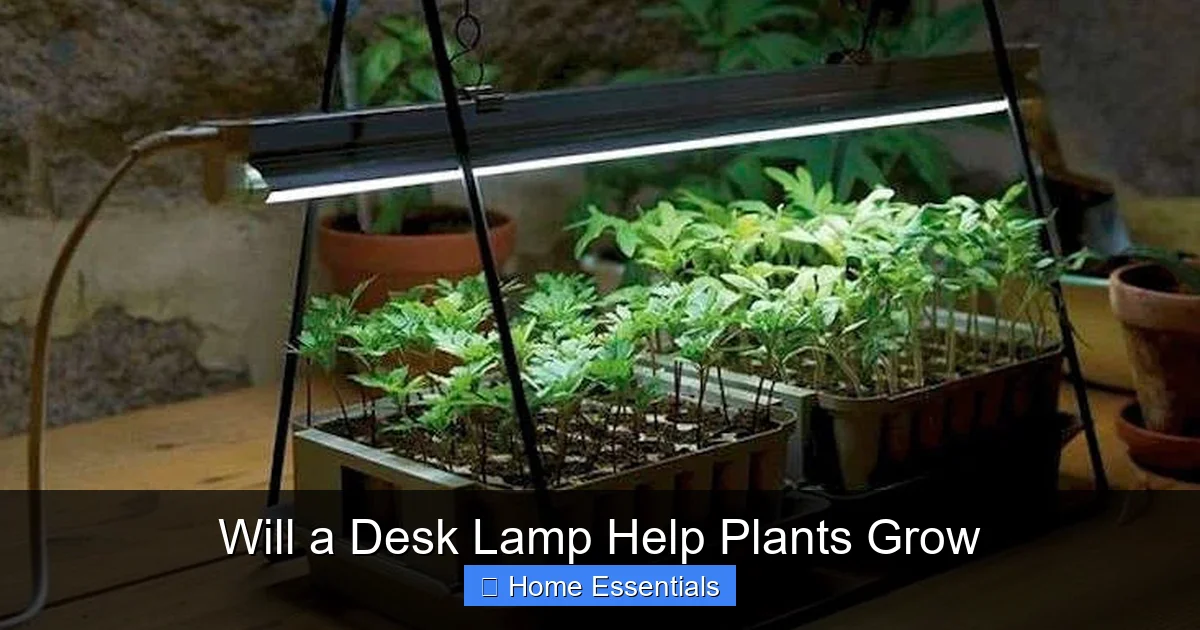
Visual guide about Will a Desk Lamp Help Plants Grow
Image source: cdn.gardenista.com
Step 1: Bulb Selection is Everything
This is the most critical step. Do not use a standard incandescent or halogen bulb. They are inefficient, hot, and have terrible spectrum. Your only viable option is an LED bulb. But not just any LED bulb.
- Look for “Grow Light” or “Full Spectrum for Plants” bulbs. Brands like GE’s “LED Grow Light” series or similar from other manufacturers. These are designed to emit a balanced spectrum for plants.
- Check the wattage equivalent. You need something with a decent output. A standard 60W equivalent LED might be 8-10 actual watts. For a desk lamp, aim for a bulb that is at least 10-15 actual watts of power to have a chance at meaningful PPFD at close range. Higher is better, but watch for heat.
- Consider a “smart bulb” with a high lumen output and full spectrum. Some smart bulbs can be tuned to a “daylight” or even a specific grow spectrum via an app. This is a modern, flexible solution. You can read about how smart bulbs work to understand their capabilities. Just ensure the specific model you choose has a high enough brightness (lumens) and a spectrum suitable for plants, not just a cool white color temperature.
Step 2: Placement and Distance
Light intensity drops off rapidly with distance from the source (inverse square law). To get enough PPFD, you must place the lamp extremely close.
- Start at 6-12 inches above the plant’s top leaves. This is very close. Ensure your lamp’s arm can hold it steadily there.
- Monitor for heat. Place your hand where the leaves are. If you feel noticeable warmth after 5 minutes, the lamp is too hot. Move it further away or get a cooler bulb. Heat stress is a silent killer.
- Watch for stretching. If the plant starts growing long, spindly stems with large gaps between leaves (etiolation), it’s screaming for more light intensity. Move the lamp closer or get a stronger bulb.
Step 3: Duration and Timing
Set a timer. Seriously. You will forget.
- Aim for 12-18 hours of “on” time. For low-light plants, 14-16 hours is a good starting point. This simulates a long summer day and compensates for the lower intensity.
- Use a simple outlet timer. They are cheap and foolproof. Don’t rely on remembering to turn it on and off.
- Ensure a dark period. Plants need rest. Do not run it 24/7. A 6-8 hour dark period is essential for plant health and circadian rhythms.
Step 4: Manage the Environment
A lamp in a small space affects more than just the plant.
- Watering will change. The soil will dry out much faster under a lamp, especially a warm one. Check moisture daily. Overwatering is a common mistake when adding artificial light.
- Consider a reflective surface. Place a piece of cardboard or a mirror behind the plant to bounce light back onto the leaves from the sides, increasing overall exposure.
- Rotate the plant. If your lamp is fixed, the plant will grow toward it. Rotate the pot 90 degrees every few days to encourage even growth.
When to Upgrade to a Real Grow Light: Clear Warning Signs
How do you know your desk lamp experiment isn’t cutting it? Your plant will tell you. Here are the unambiguous signs it’s time to invest in proper equipment.
The Plant’s Physical Pleas
- Severe Legginess: The plant is growing long, thin, pale stems with tiny, widely spaced leaves, desperately reaching for the light source. This is etiolation and is a definitive failure of the light system.
- No New Growth or Very Slow Growth: During the active growing season (spring/summer), the plant produces no new leaves or stems for months. It’s in survival mode, not growth mode.
- Leaf Color Changes: Leaves turn pale green or yellow (chlorosis) because the plant can’t produce enough chlorophyll. Alternatively, they may become very dark green as the plant produces extra chlorophyll in a desperate attempt to capture scarce light.
- Leaf Drop: The plant starts dropping its lower leaves to conserve resources for new growth at the top, which is still struggling.
Your Goals Have Outgrown the Lamp
- You want flowers or fruit. If your goal is to see blooms or harvest something edible, a desk lamp is a non-starter. The intensity and specific red light spectrum required for flowering are far beyond what a desk lamp provides.
- You’re growing food. For herbs, lettuce, or tomatoes, you need high PPFD for compact, tasty growth. A desk lamp will yield weak, bitter, sparse results.
- You have multiple plants. Trying to light a shelf of plants with individual desk lamps is inefficient, messy, and will never provide uniform coverage. A single panel or bar light is the solution.
When you see these signs, it’s time to shop for a small, efficient LED grow panel or bar. They are now affordable, energy-efficient, and designed specifically for this task. Using an underpowered light is more cruel than using no supplemental light at all, as it confuses the plant’s growth signals without providing the energy to follow through.
Conclusion: The Honest Verdict on Desk Lamps and Plant Growth
So, will a desk lamp help plants grow? The honest, nuanced answer is: it can keep a very low-light, foliage-only plant alive and prevent severe decline in a dark room, but it will not promote robust, healthy, or flowering growth for the vast majority of plants. It’s a tool of last resort or a minor supplement for the hardiest of survivors.
If you choose to try, your success hinges entirely on three things: a cool-running, high-wattage, full-spectrum LED bulb; placing it inches from the plant; and running it on a strict timer for long hours. You must manage your expectations. That pothos might not die, but it won’t thrive or produce new leaves quickly. For anyone serious about growing anything beyond the most basic shade-tolerant foliage, or for anyone wanting to grow food or flowers, the investment in a small, dedicated LED grow light is not just recommended—it’s essential. It’s the difference between a plant that’s just hanging on and one that’s truly flourishing. Your desk lamp is for your books and your laptop. Save the serious growing for the tools built for the job.
Frequently Asked Questions
Can I use any LED desk lamp for plants?
No. Only LED desk lamps using a bulb specifically marketed for plant growth (full-spectrum) have the correct light spectrum. Standard “daylight” or “soft white” LED bulbs lack the necessary blue and red wavelengths and are inefficient for photosynthesis.
How close should a desk lamp be to a plant?
For a high-wattage plant bulb, start 6-12 inches above the top leaves. This is very close. You must constantly monitor for heat—if the lamp feels warm to the touch near the leaves, move it further away to prevent leaf burn.
How many hours a day should I run a desk lamp for plants?
Aim for a consistent 12-18 hours of light per day, using a simple outlet timer. This mimics long summer days. Ensure there is also a 6-8 hour uninterrupted dark period, as plants need this rest for healthy metabolism.
Is a desk lamp more cost-effective than a grow light?
No. While using an existing lamp seems cheap, standard inefficient bulbs cost more in electricity for the tiny amount of usable light they produce. A proper, small LED grow panel is more energy-efficient and effective, saving money and your plant’s health in the long run.
My plant is getting leggy under the desk lamp. What’s wrong?
Legginess (long, thin stems with sparse leaves) is the classic sign of insufficient light intensity. Your desk lamp, even if close, is not providing enough photons (PPFD). The plant is stretching desperately toward a stronger light source. You need a more powerful, closer, or better-spectrum light source.
Can a desk lamp help a plant in a north-facing window?
Yes, but only as a supplement for very low-light tolerant plants like a snake plant or ZZ plant. It can help prevent decline during dark winter months. It will not, however, transform a north-facing window into a bright, east-facing one for medium or high-light plants.